

At-home ketamine therapy has expanded fast. There are more providers now, more options, more programs that sound pretty similar, at least on the surface. But the differences that matter aren’t always front and center.
Some programs are genuinely thoughtful, built around real clinical oversight, real screening, and care that adjusts as you respond. Others have the right language on the page but not the infrastructure behind it.
Price, turnaround time, and whether a licensed provider is involved — those matter. But they leave out the questions that tell you how a program actually works once you’re in it, and whether it’s built to stay with you over time.
What to Know Before You Choose a Ketamine Therapy Provider
Depression and anxiety are not small issues. Major depressive disorder affects an estimated 21 million adults in the US; anxiety disorders affect even more, with roughly 18% of the adult population impacted at any given time. For many of them, standard treatments, like SSRIs, SNRIs, and talk therapy, either never fully worked or stopped working somewhere along the way.

Ketamine research has shifted that picture: meta-analyses show 50 to 70% of patients with depression experience at least a 50% reduction in symptoms with ketamine treatment. For anxiety, a systematic review of randomized controlled trials found that four of six studies showed significant improvement in anxiety scores with ketamine compared to control groups, with maintenance treatment associated with sustained effects over time.
Which is why more people are looking into it, and why more ketamine providers have shown up to meet that demand.
A legitimate at-home program covers the basics:
- A genuine medical evaluation by a licensed clinician — not a checkbox survey
- Prescription ketamine filled through an independent, licensed pharmacy
- Dosing instructions specific to you, not a generic protocol sent to everyone
- Real clinical support once treatment begins, not just at sign-up
That’s the floor. What distinguishes a program worth choosing is everything that happens beyond it.
The Criteria That Actually Matter When Comparing Ketamine Providers
If you’ve spent any time researching at-home ketamine, you’ve probably noticed that most programs sound similar. Licensed clinicians. Safe and effective. Personalized care. The question is what it actually looks like once you’re in the program.
Here’s what to look for.
A Starting Point That Fits, and Flexibility That Lasts

Not everyone comes to at-home ketamine therapy from the same place. Some people are in acute distress. Some are managing something low-grade and persistent. Some have tried many treatments. Others are starting fresh.
A program built for real flexibility accounts for that — at intake and throughout. That means:
- More than one way in, with different dosing levels and intensities depending on what you actually need
- A real conversation about where to begin, not a single protocol applied to everyone
- The ability to adjust as your response evolves — not just in the first few weeks, but over the full course of treatment
How you respond in month one is rarely how you respond in month four. Stress changes. Life changes. A program that only offers flexibility at the start and then locks you into a fixed protocol isn’t actually flexible.
Treatment that stays calibrated to where you are is treatment you can sustain.
Care That Adjusts Over Time
The programs worth choosing build adjustment into the model from the start. Check-ins are built in. Dosing can change. The goal isn’t to lock you into a protocol — it’s to stay responsive to what’s actually happening.
A useful question to ask any provider: What happens if I need a change? How does that work, and who do I actually talk to? The answers tell you a lot about how the program is really structured.
A Nervous-System-First Approach to Ketamine Therapy for Anxiety and Depression
Some programs treat ketamine for depression and anxiety as a standalone fix. You take it; it works, or it doesn’t. But ketamine creates what’s called an enhanced neuroplastic window: a state where the brain’s capacity for change is significantly amplified.
Responses that used to feel automatic and unchangeable become something you can actually work with. It’s not the experience itself that produces lasting change; it’s what happens inside that window.
A nervous-system-first approach means the program thinks beyond the prescription:
- How does treatment fit into your life?
- What’s the goal — acute relief, or cumulative, sustainable change?
- Is the model built around a single intervention, or designed to compound over time?
This framing matters especially for people exploring ketamine therapy for anxiety. Anxiety is often a nervous system pattern that’s been running for a long time — old programming that shapes how you respond to stress before you’ve had a chance to think. A program designed around nervous system regulation over time is more likely to produce change that holds.
Most programs focus on the experience itself. A program worth choosing owns the full loop: what happens inside that window, and how change gets integrated into daily life.
Understanding Dosing Models — and Why Low-Dose Deserves Attention
Most ketamine programs are built around intensive short-course protocols: a bolus dosing model where patients complete several higher-dose administrations over a compressed window — typically one to two sessions per week for six to eight weeks — followed by monthly maintenance. That model has evidence behind it and works for some people.
But it’s not the only valid approach, and for many people it’s not the most sustainable one.
A window of enhanced neural growth
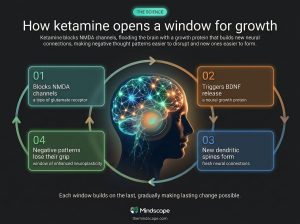
Ketamine blocks NMDA channels — a type of glutamate receptor — triggering a surge of neural growth that makes negative thought patterns easier to disrupt and new ones easier to form. How a program uses that window is where dosing models diverge.
The Low-Dose Advantage
Low-dose ketamine administered more consistently tells a different story. In a Mayo Clinic study of patients with severe depressive episodes — including both major depressive disorder and bipolar disorder — who hadn’t responded to at least two antidepressants, low-dose ketamine performed as well as higher doses: 8 in 10 showed at least 50% symptom improvement, and 5 experienced full remission. Consistent low-dose treatment tends to be less disruptive, easier to sustain, and produces change that accumulates gradually rather than arriving all at once.
A provider worth choosing will have an honest conversation about which approach is right for you — not default to the model that’s easiest to operationalize.
At-Home Ketamine Treatment That Fits Real Life

Ketamine therapy works best when you can actually do it.
The practical reality of at-home treatment:
- No commute, no clinic schedule, no designated driver
- Medication delivered to your door
- Sessions on your timeline, not around an office’s availability
- Consistent care that doesn’t require rearranging your life every time
For people managing work, family, or anything else that doesn’t pause for an appointment, that’s not a minor convenience. It’s often the difference between starting and not starting.
A licensed clinician reviews your case and stays involved throughout — but in a well-built program, that oversight runs in the background. You shouldn’t have to work around it.
Frequently Asked Questions
What should I look for when choosing an at-home ketamine therapy provider?
Real dosing flexibility, care that adjusts as you respond, and a program designed to fit into your actual life. Clinician oversight and licensed pharmacy fulfillment are baseline requirements — what distinguishes a good ketamine provider is everything they offer beyond that.
How do at-home ketamine therapy providers ensure patient safety?
A real medical assessment before anything is prescribed, medication from a licensed pharmacy, and ongoing clinical involvement. In a well-built program, those aren’t separate features. They’re standard.
How is low-dose ketamine different from intensive short-course protocols?
Many programs use a bolus dosing model — higher-dose administrations compressed into a short treatment window, then monthly maintenance. Low-dose, consistent treatment works differently: smaller doses, more regular frequency, with the goal of cumulative nervous system regulation over time rather than a series of acute interventions. Both approaches have evidence. They suit different people and different goals.
Which at-home ketamine therapy services are most accessible for anxiety patients?
The ones designed around real life — flexible dosing, no clinic schedule, and care that adjusts as you respond. For ketamine therapy for anxiety specifically, look for programs that think about nervous system regulation over time, not just symptom relief from a single round of treatment. Accessibility isn’t just about price. It’s about whether you can actually sustain it.
Find an At-Home Ketamine Provider That Clears the Bar
The criteria in this post aren’t a wish list. They’re the baseline for what good care actually looks like.
Ketamine therapy with Mindscape is built around exactly that: low-dose, nervous-system-first, and designed to adjust as you respond. Flexible dosing from the start. Care that stays calibrated over time. Treatment that fits into real life — not the other way around.
If that’s what you’ve been looking for, begin your Mindscape assessment here.
hi