
Ketamine therapy isn’t one thing anymore.
A decade ago, the only option was an IV infusion clinic: high-dose sessions in a medical setting, typically costing $400–$800 per visit, with a nurse monitoring your vitals the entire time. It was effective for many people, but it was also expensive, location-dependent, and hard to sustain.
Today, at-home ketamine therapy has expanded access significantly. Physician-prescribed ketamine is shipped to your door, and treatment happens in your own space, with ongoing clinical oversight coordinated via telehealth. Both models are legitimate. Both use the same medication. But they differ in meaningful ways, and the right choice depends on what you’re dealing with, what kind of support you need, and what you’re actually trying to get out of treatment.
This post breaks down how each format works, where they overlap, and where they diverge, so you can make an informed decision about the best choice for your needs.
What is ketamine therapy?
 Ketamine is a medication originally developed as an anesthetic. Over the past two decades, clinical research has demonstrated its effectiveness for treatment-resistant depression, anxiety, PTSD, and chronic pain, often producing results faster than traditional antidepressants.
Ketamine therapy uses sub-anesthetic doses of ketamine, meaning doses well below what would be used for surgery. At these levels, ketamine interacts with NMDA receptors in the brain, influencing glutamate signaling and supporting neuroplasticity, meaning the brain’s capacity to form new neural connections and release rigid patterns.
In practical terms, people often describe the effect as a softening, in which the grip of negative thoughts loosens, leading to reduced emotional reactivity and greater access to calm and ease.
There are several ways ketamine is administered, and the delivery method shapes the experience, cost, and clinical context of treatment.
At-Home Ketamine vs. IV Ketamine Clinics: How Each One Actually Works
Ketamine therapy comes in two primary formats, built around different assumptions about how treatment should work. Neither is universally better. But they are genuinely different, and understanding those differences makes it easier to figure out which one fits your situation.
IV Ketamine Clinics
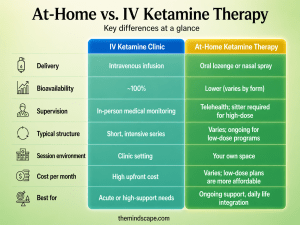
IV ketamine is delivered directly into the bloodstream through a catheter. Sessions run 40 to 60 minutes in a medical facility, with a nurse or clinician present throughout, monitoring blood pressure, heart rate, and oxygen levels.
Because the medication enters the bloodstream directly, IV has 100% bioavailability: the full prescribed dose reaches the system, and the infusion rate can be adjusted in real time if needed.
Most IV clinics follow a short-course protocol: six infusions over two to three weeks, with maintenance sessions spaced further apart. It is an intensive, front-loaded model. The goal is rapid, significant symptom reduction in a compressed window.
Cost and access. Sessions typically run $400 to $800 each. A standard six-session course comes to $2,400 to $4,800 or more. Most IV clinics do not accept insurance.
Who it fits. People in acute crisis, with severe treatment-resistant depression, or with complex medical histories that require in-person monitoring.
At-Home Ketamine Therapy
At-home ketamine is prescribed by a licensed clinician through a telehealth consultation, compounded by an independent pharmacy, and shipped to the patient. The most common format is Oral lozenges (troches or ODTs): absorbed through the lining of the mouth.
Mindscape is one of the only companies offering both troches and ketamine nasal spray. Nasal delivery has a faster onset and a slightly shorter duration than oral methods.
Bioavailability via sublingual absorption is approximately 20 to 35%, which is why prescribed doses are calibrated in higher milligrams to achieve equivalent therapeutic effect. The experience is more gradual in onset, subtler in feel, and compatible with daily functioning.
Telehealth check-ins and safety protocols are standard. Some higher-dose at-home programs require an in-person or virtual sitter to be present during the setting, but this isn’t necessary with low-dose options. Most at-home programs cost less than IV ketamine, and they offer accessibility and a care structure that fits around your life.
Cost and access. Monthly costs typically range from $150 to $450, covering the clinician consultation, medication, and ongoing care coordination.
Who it fits. People with persistent symptoms who want to integrate treatment into daily life, including those who have not responded adequately to antidepressants or therapy. Also the more accessible option for anyone facing geographic, financial, or logistical barriers to clinic-based care.
Not All At-Home Ketamine Programs Are the Same
This is where it is worth slowing down.
Most at-home ketamine platforms follow a similar basic structure: telehealth evaluation, prescribed medication, shipped to your door. But the models diverge significantly in how they approach dosing, care coordination, and what happens after the prescription is filled.
Two models, two different philosophies:
Short-course, higher-dose. Some platforms follow a protocol similar to IV clinics: around six sessions over several weeks, often with guided experiences and integration coaching. A sitter is usually required. This is essentially the IV clinic model translated to the home setting, with oral medication substituted for IV delivery.
Daily low-dose. Other platforms, including Mindscape, use a precision low-dose protocol built around daily or near-daily consistency. Rather than front-loading intensity and spacing sessions weeks apart, this model works with the nervous system through repeated, tolerable contact with a more regulated internal state. The dose is personalized and adjusted over time by the prescribing clinician as the patient’s response evolves.
Why the distinction matters:
- Intensive short-course protocols are designed for rapid symptom reduction
- Daily low-dose protocols are designed for cumulative change, less dramatic per session, but building meaningfully over time
- The model shapes how the treatment feels like day to day, and also what kind of change it supports
See a side-by-side provider comparison .
Is sublingual ketamine as effective as IV?
This is one of the most common questions, and the honest answer is: it depends on what you mean by “effective.”
IV ketamine produces more predictable blood levels per session because it bypasses digestion entirely. For acute, crisis-level symptoms, precision and speed are clinically meaningful.
But effectiveness isn’t only about peak blood concentration in a single session. A 2022 study published in the Journal of Affective Disorders — one of the largest on at-home sublingual ketamine — found that 62.8% of patients reported a 50% or greater reduction in depression symptoms. Those results are comparable to the success rates commonly cited for IV protocols.
For many people, the question isn’t which route produces the highest blood level in one sitting. It’s which model they can actually sustain. A treatment that fits into daily life, that someone can afford month over month, and that can be adjusted with their clinician as their needs evolve — that matters at least as much as peak bioavailability.
What to consider when choosing
 The best way to approach this may be to consider what matters most to you going in.
If you’re in acute crisis—meaning symptoms are severe, rapidly escalating, or include suicidal thoughts—IV ketamine with in-person medical monitoring may be the appropriate starting point. The precision of IV dosing and real-time intervention are important in these high-acuity situations.
If you need immediate support in the U.S., call or text 988 (Suicide & Crisis Lifeline).
If you’ve tried therapy and medication but still feel stuck, and your symptoms are persistent but not acute, or going into an onsite clinic would be a challenge, at-home ketamine therapy offers a lower-barrier way to begin—and, with low-dose daily models, a way to integrate treatment into your life rather than organize your life around it.
If cost or geography is a barrier, at-home therapy is significantly more accessible. IV clinics are concentrated in major metropolitan areas. At-home ketamine is available in 30+ states through various telehealth platforms.
If continuity matters to you, look for a model that you can realistically sustain over time. Some programs treat ketamine therapy as a fixed course: you complete the sessions, and you’re done. Others make pricing clear and straightforward while providing consistent clinical support to help you build steadily towards meaningful, long-term change.
Mindscape goes further by offering dose tiers and medication form choices, so you can work with your clinician to find what actually fits you, and adjust as you go.
If safety and oversight are top of mind, ask specific questions: Is the prescribing clinician independently licensed? Is the pharmacy independently operated and certified? What happens if you need a dose adjustment between appointments? The answers reveal more about a provider’s care infrastructure than any marketing claim.
Frequently Asked Questions
Can you switch from IV ketamine to at-home ketamine?
Yes. Some people use IV ketamine for acute stabilization and transition to an at-home protocol for ongoing maintenance. You can coordinate the switch between the two providers.
Why is at-home ketamine cheaper than IV?
At-home eliminates clinic overhead: facility costs, nursing staff, medical equipment, and IV supplies. Medication is compounded by an independent pharmacy and shipped directly. That medication-forward model is what drives the cost difference.
Does insurance cover either option?
Most IV clinics and at-home providers do not accept insurance directly, though some patients can submit for partial reimbursement. Spravato (esketamine nasal spray) is FDA-approved and may be covered, but must be administered in a certified facility.
What about Spravato?
Spravato is FDA-approved esketamine, prescribed specifically for treatment-resistant depression and administered in a certified healthcare setting. It is a different product, regulatory pathway, and clinical experience from compounded at-home ketamine or IV racemic ketamine.
Is at-home ketamine safe?
Generally well-tolerated when prescribed by a licensed clinician, dispensed by a certified pharmacy, and taken as directed. Common side effects include mild nausea, dizziness, and altered perception during the session window, though these are rare with lower doses. Providers with LegitScript certification, independent clinical oversight, and structured dose adjustment protocols offer the strongest safety infrastructure.
Mindscape is a care-coordination platform for at-home ketamine therapy, working with independent licensed clinicians and independent pharmacies across 30+ states. Mindscape uses precision low-dose protocols personalized to each member’s needs, with care that adjusts over time. Mindscape holds LegitScript dual certification (Pharmacy + Telemedicine).
hi