

Ketamine has been used in medical settings since the 1960s. Its application for depression, anxiety, and PTSD is more recent, and at-home delivery is a newer model within that. People researching this treatment tend to have specific questions: what side effects to expect, what happens the next day, what the long-term side effects are, and whether doing this at home introduces meaningful additional risk. This post addresses those questions directly, with Mindscape’s low-dose daily model in mind.
What are the most common side effects of ketamine therapy?

Side effects vary by dose, delivery format, and individual physiology. The most commonly reported effects during or shortly after a therapeutic ketamine dose include:
Dissociation and perceptual changes
At low therapeutic doses, ketamine may produce a mild sense of detachment, slight shifts in time perception, or a floaty quality. These effects are dose-dependent and typically resolve within 30 to 90 minutes for oral and intranasal formats. They are generally milder at the low-dose tier than in IV or higher-dose formats.
Nausea and dizziness
Common in early sessions, particularly with nasal spray delivery. For most people, these settle after the first one to two weeks as the body adjusts.
Elevated heart rate and blood pressure
Ketamine temporarily increases cardiovascular activity. Generally well-tolerated in healthy individuals, but worth discussing with your clinician if you have any cardiovascular conditions.
Emotional sensitivity
During and in the hours following a dose, some people notice heightened emotional access, including feelings or memories surfacing that had been in the background. In a structured program, this can be a meaningful part of the process.
Fatigue
More common at higher dose tiers and tends to diminish as the protocol continues.
At lower therapeutic doses in consistent daily protocols, dissociative and physiological effects are typically milder than those associated with IV or higher-dose formats. For a direct delivery comparison, see At-Home Ketamine vs. IV Ketamine: Which Is Right for You?.
What are ketamine side effects for depression?
Ketamine side effects for depression overlap with the general profile, with a few considerations specific to this treatment context.
How the antidepressant effect works
Ketamine’s antidepressant effects are believed to work in part by promoting neuroplasticity, the brain’s capacity to form new connections. These effects typically appear within 24 to 72 hours of a dose. As the medication clears between doses, some people notice a temporary dip in mood. In low-dose daily protocols, this is often less noticeable because the dosing interval is shorter and the cumulative effect of consistent dosing builds over time.
Emotional surfacing
Some people find that ketamine creates a window in which difficult feelings become more accessible — offering a fresh perspective or a point of entry for insight that’s harder to reach otherwise. This can occasionally feel uncomfortable, especially early in treatment. As you become more accustomed to the process, that discomfort tends to shift.
Dissociation: What to expect
Dissociation is one of ketamine’s known effects at any dose. At low therapeutic doses, it is generally mild and short-lived — most people describe it as a subtle shift in awareness rather than a strong altered state. For many people, the effect lessens with continued use as the body becomes familiar with the medication.
For context on treatment-resistant depression and how ketamine fits in, see Depression That Doesn’t Go Away: What’s Really Going On.
What are ketamine next-day side effects?
At oral and intranasal therapeutic doses, most physiological effects resolve within the active dosing window, typically 30 to 120 minutes. Ketamine next-day side effects at these doses are generally mild to negligible. What patients most commonly report the following day:
Residual calm or mood lift
Many people describe a carryover sense of steadiness or ease the following day. This is one of the more commonly reported next-day experiences in low-dose daily protocols.
Mild fatigue
More common at higher dose tiers. Typically resolves by mid-morning.
Sleep effects
Some people report more vivid dreams or slightly lighter sleep the night of a dose.
Cognitive function
At therapeutic doses, most people report no meaningful impairment the following day. Driving and normal daily function are generally unaffected by a prior evening dose, though it is worth monitoring your own response in the early weeks of treatment.
Next-day effects are dose-dependent and tend to become more predictable as the body adjusts to a consistent protocol.
What are ketamine long-term side effects?
Urinary tract effects
Heavy recreational ketamine use has been associated with bladder complications. This has been documented in recreational users consuming very high quantities daily over years, doses far above anything used in therapeutic programs. At therapeutic doses within supervised programs, urinary complications are rarely reported. If you have any preexisting urinary conditions, discuss them with your prescribing clinician before starting.
Cognitive effects
Dose- and frequency-dependent. At recreational doses, measurable impairment has been documented. At therapeutic low doses, the evidence is more mixed, and in some research, cognitive symptoms related to depression have actually improved alongside mood.
Tolerance
With consistent use, the overt ketamine experience often becomes more subtle over time. In supervised therapeutic use, this is generally understood as the nervous system adjusting to the protocol, not as the treatment stopping work. Dose changes, when needed, are made through a clinician visit. For more on how the nervous system responds over time, see How a Nervous System Reset Can Help Rewire Your Brain.
Psychological dependence
With frequent, unsupervised, or self-escalating use, ketamine has a recognized potential for psychological dependence. In structured programs, controlled dispensing and required clinical oversight are essential safeguards. A systematic review showed that most patients receiving ketamine for depression, including those using oral and intranasal administration, do not develop dependence. Out of 2174 patients, only 4 showed signs of tolerance and escalating use.
Is at-home ketamine therapy safe?
 Safety in at-home ketamine delivery is substantially program-dependent. The medication’s risk profile at therapeutic doses is well-characterized. What matters most in an at-home context is the structure around it.
Prescriber independence: A licensed physician should conduct intake assessment, screen for contraindications, and retain authority over dosing decisions. At Mindscape, prescribing clinicians are independent of the platform, which means clinical decisions are not shaped by commercial interests. Members request their preferred dosage tier and medication form, which is subject to clinician approval.
Pharmacy certification: Medication should be dispensed through a licensed pharmacy. LegitScript certification covering both telemedicine and pharmacy operations is a verifiable compliance indicator.
Eligibility screening: Contraindications should be assessed before prescribing, including medical history, psychiatric history, substance use history, and current medications.
For a provider-by-provider breakdown of these variables, see Best At-Home Ketamine Therapy: How to Choose a Provider and our At-Home Ketamine Provider Comparison.
Who should not use ketamine therapy?
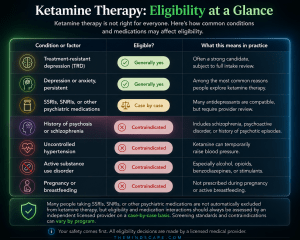
Ketamine is not appropriate for everyone. Contraindications assessed during clinical intake typically include:
- Uncontrolled or poorly managed hypertension
- Personal or family history of schizophrenia, schizoaffective disorder, or psychosis
- Active or recent substance use disorder, particularly involving alcohol, opioids, benzodiazepines, or stimulants
- Pregnancy or active breastfeeding
- Significant cardiac conditions, epilepsy, or history of seizures
- Active, untreated thyroid disease
Individuals on SSRIs, SNRIs, or other psychiatric medications are not automatically excluded but require individual clinical assessment. Ketamine and SSRIs are not categorically incompatible, but drug interactions should be reviewed by a prescribing physician. See the At-Home Ketamine Provider Comparison for how eligibility screening varies by program.
Frequently Asked Questions
What are ketamine long-term side effects?
The most documented long-term risks are urinary tract effects from heavy recreational use, cognitive effects that are dose- and frequency-dependent, and psychological dependence with unsupervised or escalating use. At therapeutic doses within physician-directed protocols, these risks are substantially lower.
What are ketamine side effects for depression?
The most commonly reported effects include a mild sense of detachment during the dosing window, emotional sensitivity in the hours following, and some mood variability as the antidepressant effect fluctuates between doses. At lower doses on a consistent schedule, these effects are generally mild.
What are ketamine next-day side effects?
At therapeutic oral and intranasal doses, next-day effects are typically limited to mild residual fatigue and, for many people, a carryover sense of calm. Cognitive function is generally intact by the following morning. Sleep effects, including more vivid dreaming, are reported by some people the night of a dose.
Is at-home ketamine therapy safe?
Safety is program-dependent. At-home ketamine therapy delivered through a physician-directed, properly licensed program carries a substantially different risk profile than unmonitored use. Independent prescribers, licensed pharmacy dispensing, required clinical contact, and ongoing monitoring are the structural variables that matter most. For a provider comparison, see the At-Home Ketamine Provider Comparison.
What are the real risks of doing ketamine at home?
The primary risks are inadequate eligibility screening, inappropriate dosing for the individual, and limited clinical oversight once treatment begins. These are structural risks rather than risks inherent to the medication itself. A well-designed program addresses them through independent prescribers, rigorous intake screening, pharmacy-controlled dispensing, and ongoing clinical contact.
Can you get addicted to at-home ketamine?
Ketamine has a recognized potential for psychological dependence with prolonged unsupervised or high-frequency use. In physician-directed programs with controlled dispensing, this risk is mitigated by the structure of the protocol. Individuals with a history of substance use disorder require additional clinical evaluation before starting treatment.
Who should not try ketamine therapy?
Primary contraindications include a history of psychosis or schizophrenia, uncontrolled hypertension, active substance use disorder, and pregnancy. A prescribing physician should conduct a full medical history review before issuing any prescription.
Mindscape is a physician-directed, at-home ketamine care platform available in 30+ states, LegitScript certified in both Telemedicine and Pharmacy. To find out whether ketamine therapy may be appropriate for you, take the Clarity Quiz.
hi