

If you’ve started researching ketamine microdosing, you’ve probably noticed it’s hard to find a straight answer about how it actually works — what the doses feel like, how often you take it, and whether it’s meaningfully different from other ketamine protocols.
This post breaks down the fundamentals of ketamine microdosing. We also cover why the low-dose daily model is built around a different idea of how change happens, compared to short-course, higher-dose programs.
Already comparing specific programs? Read our breakdown of at-home ketamine therapy options for clarity around how different models really work in practice.
What does ketamine microdosing really mean?
If you’ve come across the word “microdosing” before, it was probably in the context of psilocybin or LSD, meaning tiny amounts taken on a schedule, sub-perceptual by design. Ketamine microdosing is a different thing. It means sub-psychedelic dosing: low enough that you stay fully oriented, coherent, and able to function. You are not going on a trip.
Clinicians sometimes call this range subanesthetic or psycholytic dosing. The experience is subtle. The effect on the brain is not.
What Makes Ketamine Microdosing Different
Ketamine therapy broadly splits into two structural approaches. They are not just different price points. They are built around different ideas about how change happens.
Low-Dose Daily Protocol (Ketamine Microdosing)
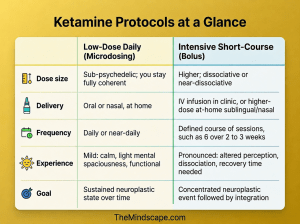
This model uses small, frequent doses taken consistently over time, usually via oral troches, at home. The doses stay below the dissociative threshold: you remain clear-headed and functional throughout. You are not setting aside a day for recovery.

The logic is cumulative. Instead of one concentrated experience, the goal is to repeatedly return to an enhanced neuroplastic window, or a more flexible state where old patterns become easier to notice and work with over time. Some low-dose programs use a narrow, standardized structure. Others offer more flexibility as needs evolve over time.
Mindscape gives members a choice of three dosage tiers: Ground, Flow, and Rise, with both oral and nasal delivery options. (Some people find nasal ketamine better suited to their routine, comfort level, or treatment goals.) A Ground microdose feels very different from a Flow or Rise dose, so the protocol can meet people where they are instead of forcing everyone into the same structure.
Intensive Short-Course Protocol (Bolus Dosing)
This model delivers higher, more concentrated doses over a small number of sessions. It’s common for IV infusions in a clinic, though some at-home models use higher dose levels.
Also known as bolus dosing, the high-dose approach creates a more intense, dissociative experience over a compressed timeline. For some people, that intensity can feel meaningful, clarifying, or emotionally significant very quickly.
But an intense experience doesn’t always equate to lasting integration. A powerful session can open the door to change without necessarily altering the underlying patterns. Until those patterns are addressed, it can be difficult to significantly shift your baseline.
In Mindscape’s low-dose model, the emphasis isn’t on chasing peak experiences. Instead, it supports repeated nervous-system contact with a more regulated, responsive state that’s carried into ordinary life. Over time, that calmer, more receptive state can become the new normal.
How Does Ketamine Make You Feel at Low Doses?
This is usually the first thing people actually want to know. And the answer is almost always a surprise: it’s much quieter than people expect.
At sub-psychedelic doses, a ketamine microdose typically brings:
• A mild sense of calm or lightness
• A slight softening of mental noise
• Some emotional openness
• Full orientation
• Effects that resolve within a few hours
What most people do not experience at this level: intense visual distortion, dissociation, or anything resembling a psychedelic experience.
What Are the Different Ways People Do Ketamine Therapy Now?
Ketamine therapy options include:
• IV infusion in a clinic
• Intramuscular injection
• Intranasal esketamine (Spravato)
• At-home oral ketamine
• At-home nasal spray
The distinction that matters most is not the dose itself. It’s whether the program is built around concentrated experiences or ongoing engagement with a more regulated, responsive state over time. That shapes everything: the feel, the timeline, and what you are actually trying to accomplish.
Is Sublingual Ketamine as Effective as IV?
It’s a fair question, and it deserves a straight answer rather than a hedge.
IV ketamine has 100% bioavailability because it enters the bloodstream directly. Oral and sublingual routes have lower bioavailability, roughly 20 to 30% via buccal absorption.
More importantly, they are built for different things. IV and higher-dose episodic protocols are generally designed around concentrated neuroplastic experiences: creating a larger window of change over a shorter period of time.
Much of the published ketamine research has focused on intermittent IV protocols for rapid symptom reduction. But ongoing studies on low-dose and sublingual ketamine are consistently showing effectiveness as a mental health treatment.
Can the Dose Be Adjusted Over Time?
Yes. And in a well-run protocol, it should be. Dose adjustment is not a sign that something went wrong. It is how the model is supposed to work.
Most at-home programs include some titration, but the flexibility they offer varies. A narrow dose range or single delivery format limits how far the protocol can adapt.
 At Mindscape, tier or form changes require a short provider visit. Two are included in the first 6 months of membership (routine provider check-ins are always free). This ensures dose changes are clinically informed and responsive to what is actually happening.
If you’re trying to figure out which type of ketamine program actually fits your goals, pace, and comfort level, you can learn more about Mindscape’s low-dose, flexible approach here.
Ketamine therapy is not one thing, and understanding that is more useful than any single recommendation. The dose, the delivery, the frequency, and the philosophy behind the protocol all shape what the experience is and what it can actually do.
Ready to explore whether a low-dose, flexible at-home approach might fit you? Get started at Mindscape.
hi