











It’s one of the more disorienting experiences in trauma healing.
You’ve done the work. You know exactly where the pattern comes from. You can trace it back to the specific dynamic, the specific person, maybe even the specific age. You’ve talked about it. You’ve journaled about it. You understand it with a clarity that would have seemed impossible a few years ago.
And then someone’s tone shifts in a meeting, or a text goes unanswered too long, and the old response is already running before you’ve made a single conscious decision.
Understanding a pattern and changing it are often two different things. For a lot of people, there comes a point where more insight stops producing more change, and that plateau feels like personal failure. But it’s not the end of the story. Read on to learn how working with the nervous system can lead to real shifts in trauma healing.
Common Patterns Associated with Trauma
The brain stores different kinds of memory in different systems. The prefrontal cortex, where insight lives, can hold the understanding: I learned to ignore my needs because expressing them felt dangerous. But the amygdala, the part of the brain that processes threat and fires automatic responses, doesn’t update based on that understanding.
That’s why you can know, completely and clearly, that you’re not in danger, and still feel the fear response land in your chest like you are. The insight is real. The pattern is also real. They just live in different parts of the brain, and research on trauma and neuroplasticity has been making this clear for years.
This isn’t a willpower problem. Trauma patterns are learned responses developed in conditions that genuinely required protective responses, which got wired in beneath the level of deliberate choice. They weren’t mistakes. They were survival. At Mindscape, we call this old programming. The problem is that old programming keeps running long after the original conditions are gone.
A few of the most common trauma patterns:

- The fawn response: moving automatically toward appeasement when conflict feels close, even with people who have never hurt you
- Defensiveness or irritability that appears before you’ve had a chance to decide whether the situation is actually a threat
- Conflict avoidance that shows up even in relationships where you know it’s safe to disagree, and still finding yourself unable to say the thing
- Panic that arrives before you’ve consciously identified what feels unsafe
- Avoiding conversations, places, or decisions that your nervous system has learned to associate with danger
- An inner voice that quickly turns mistakes into proof that you’re failing, too much, or not enough
- A negative self-image that persists even when the people around you see you very differently
- Relationship dynamics you recognize clearly from the outside, and somehow end up inside anyway
What these share is their automaticity. Some show up outwardly as anger, defensiveness, or pulling away. Others stay entirely inside as panic, shame, self-criticism, or the belief that something is fundamentally wrong with you. They don’t wait for your conscious mind to weigh in. By the time you notice what’s happening, the response has already been running for several seconds.
Why Identity Patterns Are the Hardest to Shift
There’s a specific layer underneath the behavioral patterns that makes this even more complicated: identity patterns. These aren’t just habits. They’re conclusions the nervous system drew early on about how the world works, and they’ve been reinforced ever since by the very behaviors they produce.
Identity patterns include beliefs about worth, safety, and belonging. They’re often the drivers behind a wide range of trauma patterns.
These beliefs often sound like:
“I’m too much.”
“I’m not enough.”
“If people really knew me, they’d leave.”
“I have to stay on guard.”
“I can’t trust anyone.”
“Everything is my fault.”
It can be frustrating to recognize where these beliefs come from and still hear them in your mind anyway.
Why Insight Can’t Always Create Real Change
Talk therapy can be transformative. The ability to build a coherent narrative around what happened to you, to reduce shame, to develop language for experiences that didn’t have any, is real and important.
But there are specific circumstances where insight alone stops generating new movement.
The pattern is held in the body
Chronic muscle tension. A startle response that never quite settled. A gut that tightens before the thought arrives. These aren’t being run by the narrative system. They’re being run by older, faster circuitry that language doesn’t easily reach. Functional freeze can live here too. The flatness, the difficulty accessing motivation, the sense of watching life from behind glass.
The pattern is pre-verbal
Some of the most significant shaping happens before language consolidates. Early experiences of inconsistent care, chronic low-level threat, or emotional neglect can shape the nervous system without ever becoming a story that can be told and processed as a story. There’s no memory to retrieve and reframe. There’s only a nervous system that learned certain things and has been operating from them ever since.
Overthinking is the mechanism
For some people, the analytical capacity that makes insight-building possible also becomes a way of staying in the head and away from the felt experience. More analysis produces more analysis, but not necessarily more change.
Trauma Healing Means Working With the Nervous System
What many effective trauma treatments have in common is that they work with the nervous system directly, rather than relying on insight alone.
EMDR uses bilateral stimulation, typically guided eye movements, to facilitate the reprocessing of stored traumatic memories. Research using neuroimaging shows that after successful EMDR, memories that previously activated present-threat circuitry begin activating regions associated with past-event processing. The memory remains. The brain’s response to it changes.
Somatic therapies like Somatic Experiencing work with the body’s stored responses directly, rather than the story around them. They track physical sensation, discharge responses, and the incomplete defensive movements that got frozen in the nervous system at the time of the original threat.
Neurofeedback makes the brain’s own activity visible in real time and rewards shifts toward more regulated states. It’s less about insight and more about giving the nervous system repeated practice at a different way of operating.
Ketamine-assisted treatment is increasingly relevant here. A subanesthetic dose of ketamine triggers BDNF release and activates mTOR signaling pathways, creating what Mindscape calls an enhanced neuroplastic window: a period when the brain is more open to updating long-standing patterns.
A 2023 study found that ketamine promotes new connections between brain cells in areas involved in learning and memory. During this enhanced neuroplastic window, intentionally practicing new ways of thinking and responding may help reinforce changes that can be difficult to achieve through insight alone.
Trauma Healing Happens Through Repeated Experiences of Safety
 This is one of the reasons Mindscape uses a low-dose daily approach. Rather than relying on one significant experience, the protocol is designed around repeated enhanced neuroplastic windows, giving the nervous system regular opportunities to practice a different way of responding.
Patterns that were laid down through repetition over years don’t rewire in one session. They update through repeated new experiences, practiced often enough that the old response starts to lose its automatic grip.
If you’ve done the insight work and you still find yourself back inside the pattern when it matters most, you’re not failing at trauma healing. You may have reached the point where understanding alone isn’t enough.
Wondering what kind of support might fit where you are now? Take our free assessment to see whether Mindscape could be a good fit for your next step.
→ Take the Clarity Quiz

 Glutamate is the brain’s main excitatory neurotransmitter, the chemical messenger neurons use to get each other to fire and pass information along.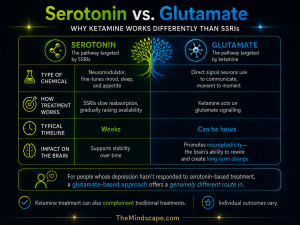

 For thirteen years I ran an investment fund, and I was good at it long enough and at a high enough level that other people used the word “prodigy.” People listened when I spoke. Doors opened. Rooms full of respect.
 So while everything external was sinking, something that I’d never known before was rising inside me. I would close the laptop on another brutal day, walk out of that room, and the day would not follow me through the door. Whatever was dying in there, stayed in there.
 About two years before the end, in the middle of the decline, a spark came back. Not the old fuel. Something new, pointed at building something new. I wasn’t rebuilding a career. I was learning, from scratch, how to be a human.
