
Is ketamine a psychedelic? The question sounds simple. The answer opens up a much bigger conversation.
The word psychedelic tends to evoke a particular kind of experience: vivid, immersive, and far removed from ordinary consciousness. Ketamine is technically classified as a dissociative anesthetic, not a classic psychedelic, and it works on a completely different receptor system than psilocybin, LSD, or DMT. But the comparison persists because ketamine can sometimes produce altered states that feel psychedelic in nature. What often gets overlooked is that some of its most interesting therapeutic applications don’t depend on that kind of experience at all.
Understanding how ketamine both overlaps and differs from classic psychedelics can give you a better idea of what a ketamine session might feel like. Perhaps more importantly, it helps clarify meaningful differences between ketamine programs, both in the experiences they provide and in their overarching treatment goals.
Is Ketamine a Psychedelic or Dissociative?
Ketamine is a dissociative. Classic psychedelics like psilocybin and LSD work primarily on serotonin receptors (5-HT2A), producing their effects through a specific neurochemical pathway. Ketamine works primarily as an NMDA receptor antagonist, blocking glutamate signaling in a way that produces dissociation rather than the classical psychedelic state.
The experiential difference is meaningful:
- Classic Psychedelics (The Serotonin Pathway): These substances tend to intensify and expand sensory and emotional experience. They amplify what is happening internally and externally, making everything feel heightened.
- Dissociatives Like Ketamine (The Glutamate Pathway): At higher doses, ketamine works by creating separation from your immediate sensory and emotional experience. It produces a floating, detached quality: a loosening of the normal sense of self and surroundings rather than an amplification of them.
Some researchers and practitioners use the term psychedelic loosely to describe any substance that produces non-ordinary states of consciousness, which is why ketamine sometimes gets included in that category. In a clinical and pharmacological sense, the distinction is real and worth understanding.
Is Ketamine Natural?
Ketamine is a synthetic compound, first developed in the 1960s as a safer anesthetic alternative to phencyclidine (PCP). It is not derived from a plant or naturally occurring organism. So in the direct sense, ketamine is not natural.
This question is particularly relevant today. Much of the renewed interest in psychedelic-adjacent therapies is connected to plant medicines like psilocybin mushrooms or ayahuasca, which carry cultural and spiritual histories. Ketamine does not share that lineage. It is a pharmaceutical compound with a long clinical track record, used in medical settings since the late 1960s. This synthetic origin has the advantage of decades of clinical use and research. Ketamine’s effects, dosing, and safety profile are documented in ways plant medicines haven’t yet. Read our post on how ketamine works to learn more about its use in mental health treatment.
Psycholytic vs. Psychedelic: Two Different Therapeutic Models
One of the most important distinctions in ketamine therapy doesn’t get enough attention, even though it shapes major differences between treatment approaches.
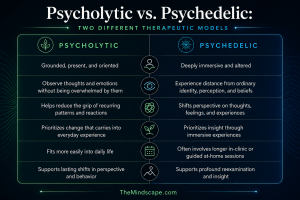 A psychedelic use of a substance aims for a full perceptual break: ego dissolution, visionary states, a radical departure from ordinary consciousness. The experience itself is often considered the mechanism. Something happens in the session that produces a shift.
A psycholytic use works differently. The goal is not a peak experience. It is to soften habitual patterns of thought and perception just enough that they become more accessible, more workable. The session is not the destination. It is the condition under which the work happens.
At low doses, ketamine is used psycholytically. The dissociation is mild or barely perceptible. What the dose does is reduce the rigidity of the mental noise, the negative thought loops, the automatic protective responses, without sending someone fully out of ordinary consciousness. There is still a you in the room. That you just has a little more room to move.
This is a different therapeutic model from the psychedelic model, and it belongs in its own category. Read our low-dose vs. high-dose ketamine therapy guide to learn more.
How Does Ketamine Make You Feel at Low Doses?
The experience at low and microdose levels is substantially different from common assumptions about ketamine. Many people are surprised to learn that not every ketamine protocol is designed around a powerful psychedelic-style experience.
Mindscape offers multiple treatment approaches, ranging from subtle daily protocols to more immersive experiences. Learn more about the program.
Microdose range (Mindscape Ground tier)
Effects are subtle and often barely distinguishable from a typical, calmer mental baseline. Some individuals notice a mild mental settling, a small reduction in the background noise of anxious thought, or a gentle ease in the body. Many notice very little dissociation and can continue with most everyday activities, though operating heavy machinery or driving is strictly off-limits.
Low dose range (Mindscape Flow tier)
A floaty or dreamy quality. Softened sensory perception. A sense of shifted awareness without losing orientation. Most people remain fully oriented to their surroundings and could hold a simple conversation, though they may choose not to. The experience is mild enough that some people find it useful for intentional work, journaling or quiet reflection, during the session window.
Upper low dose range (Mindscape Rise tier)
More noticeable inward focus. Some ego softening, a sense of the usual mental defenses easing, which creates space to process. Still well below the threshold of significant dissociation. No sitter required. But this tier typically calls for dedicated session time rather than background use.
Across all three tiers, the experience does not resemble the disorienting, visually altered state that is commonly associated with ketamine. What it offers is a modest, temporary loosening of ordinary mental rigidity, making it easier to disrupt negative thought patterns and shift your perspective.
Researching ketamine therapy options? Read our comparison guide for evaluating at-home programs.
What Psycholytic Means in Treatment
The psychedelic framing attracts a particular kind of expectation: dramatic insight, visionary experience, a before-and-after moment. For some people and some protocols, that framing is accurate. For low-dose daily ketamine, it is not, and importing that expectation into the wrong context leads to disappointment or misuse.
The low-dose model is not about spectacle. It is about opening an enhanced neuroplastic window: a period of increased neural flexibility during which the patterns that generate anxiety, depression, and emotional exhaustion are more accessible and more responsive to change. The mechanism is incremental, not transformative in a single session. The accumulation of small, consistent shifts is what produces durable change.
That is a different promise from the psychedelic model. A more modest one in some ways. A more realistic one in most.
Not sure where you’d start? Our Clarity Quiz takes a few minutes and points you toward the tier that fits where you are — Ground, Flow, or Rise.
Frequently Asked Questions
Is ketamine a psychedelic or dissociative?
Ketamine is a dissociative, not a classic psychedelic. It works on glutamate receptors rather than the serotonin pathway, producing dissociation rather than the perceptual amplification typical of classic psychedelics.
Is ketamine natural?
No. Ketamine is a synthetic pharmaceutical compound developed in the 1960s, not derived from a plant or natural source. Its clinical history predates most substances now explored for therapeutic use.
What does ketamine feel like at low doses?
At low doses, ketamine feels subtle: very little perceptible effect at microdose levels, with low doses ranging from mild mental quiet to a gentle floaty quality and slight ego-softening. The intense dissociation commonly associated with ketamine belongs to much higher dose ranges.
Is ketamine the same as a psychedelic therapy?
They share some clinical goals but use different mechanisms. Psychedelic therapy uses high-dose peak experiences as the mechanism; low-dose ketamine therapy works through daily repetition at sub-perceptual to mildly perceptible doses.
How does ketamine work differently from antidepressants?
Antidepressants work on serotonin, dopamine, or norepinephrine reuptake and typically take weeks to act. Ketamine works on the glutamate system and is associated with rapid neuroplastic changes, which is why it has shown promise for people who have not responded to conventional treatment.
hi