

At-home ketamine therapy sessions differ from in-clinic treatments in format, setting, and dosing model. What a session looks like depends primarily on whether the program uses a low-dose daily protocol or a higher-dose intermittent protocol. This post explains what a session involves from start to finish, what the medication experience is like, and how frequency and duration vary across the two main approaches.
For a broader comparison of at-home providers, dosing models, and certifications, see our guide: Best At-Home Ketamine Therapy in 2026.
What a ketamine therapy session actually looks like
At-home ketamine therapy is taken in a private setting at home, at a time scheduled around normal daily life. Sessions are not conducted in a clinical setting or with a provider physically present. All clinical oversight is handled through telehealth. A licensed clinician prescribes the medication, monitors progress, and confirms any dose adjustments.
Before any session begins, a licensed clinician conducts an initial consultation to review medical history, current medications, symptoms, and treatment goals. If approved, medication is shipped directly to the member. The session itself takes place in the member’s home using the prescribed form, most commonly sublingual troches (lozenges) or nasal spray.
Microdosing sits at the low end of the low-dose range and produces subtle effects; higher tiers bring a more noticeable softening of usual thought patterns and body tension.
The basic structure of a session:
- The member takes the medication at home in a comfortable, quiet space.
- Effects typically begin within 15–20 minutes for sublingual troches and somewhat faster with nasal spray.
- The member settles into a resting state during the active window, lying down or seated, often with eyes closed. At the microdose end of the range, this resting period may be brief or unnecessary.
- Effects subside within 1–2 hours for most low-dose protocols, and sooner at microdose levels.
- The member resumes normal activities. Driving and operating heavy machinery should be avoided for at least 1–2 hours after dosing.
What a ketamine therapy session feels like the first time
What the first session feels like depends mostly on the dose and delivery form.
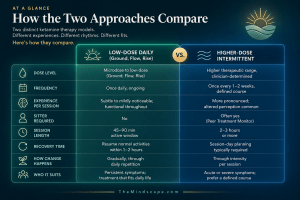
 In low-dose daily protocols (typically 50–200mg sublingual), the first session often produces a subtle perceptual shift. Common descriptions include a softening of mental chatter, mild lightheadedness, a gentle sense of calm, and a slight feeling of distance from habitual stress responses. Most people remain oriented and aware of their surroundings throughout. The experience at these doses is not psychedelic or strongly dissociative.
In higher-dose protocols, the first session is more pronounced. Significantly altered perception, disorientation, and visual changes are more common. At these doses, a clinician or sitter (often called a Peer Treatment Monitor) is typically required to be present.
For people on low-dose daily programs, Mindscape’s Our Approach page describes what many members experience over time: an initial awareness of perceptual change that, with consistent use, tends to become more embodied and grounded as the nervous system acclimates.
What do you actually do during a session?
In low-dose daily protocols, most members are not required to do anything specific during the active window. Some people choose to listen to music or rest in a meditative state, and many find that visualization, journaling, or guided exercises support shifts in perspective that contribute to greater calm and self-understanding.
Higher-dose programs typically include more structured session support, often with a guide, therapist, or clinician available before, during, or after the session to assist with preparation and integration.
 Low-dose daily protocols are designed to fit into ordinary life without requiring dedicated preparation or decompression time around each session. Higher-dose programs are structured around the session as a distinct, scheduled event.
For more on the difference between these two approaches, see At-Home Ketamine vs. IV Ketamine: Which Is Right for You? on the Mindscape blog.
How long does the effect last after you take it?
How long a session lasts depends on the medication form and the dose level.
Sublingual troches (low-dose, 50–200mg)
Onset within 15–20 minutes. Active effects last approximately 45–90 minutes. Mild residual effects may continue for up to 2 hours.
Nasal spray
Onset slightly faster than troches, typically within 10–15 minutes. Duration similar to troches at comparable doses.
Higher-dose sublingual tablets (clinician-determined dose)
Active effects commonly last 2–3 hours. Some residual effects may persist for several hours afterward, which is one reason a sitter is required for these protocols.
Subcutaneous injection (offered by some providers)
Faster onset and higher bioavailability than oral forms. Active effects typically last 1–2 hours.
At low doses, the window is short enough that most members can schedule a session in the morning or evening without significant disruption to the day. At higher doses, session-day planning is more involved.
How often do ketamine therapy sessions happen?
How often you dose is one of the biggest practical differences between the two models.
Low-dose daily protocols
Sessions occur once per day. The therapeutic model is cumulative. Consistent, daily dosing is how the protocol is designed to work. There is no dedicated session day; dosing integrates into a daily routine.
Higher-dose intermittent protocols
Sessions typically occur once every 1–2 weeks. Programs are usually structured as a defined course, commonly 6, 8, or 9 sessions, with the option to continue after completion. Each session is a scheduled, stand-alone event.
In low-dose daily models, frequency is the mechanism. The change is not built through one significant experience. It builds through consistent, daily contact with a steadier internal state, repeated enough times that something shifts in how the system responds.
Frequently Asked Questions
What is a ketamine therapy session actually like?
A ketamine therapy session at home involves taking a prescribed dose of ketamine, typically a sublingual troche or nasal spray, in a private, comfortable setting. Effects begin within 10–20 minutes. In low-dose protocols, the experience is subtle: mild perceptual softening, reduced mental chatter, and a gentle sense of calm. In higher-dose protocols, the experience is more pronounced, with significant altered perception. Duration ranges from 45 minutes to several hours depending on the dose and form.
What does ketamine therapy feel like the first time?
At low doses (50–200mg sublingual), the first session typically involves a mild shift in awareness rather than a strong psychedelic or dissociative experience. Many people describe reduced mental noise and a soft sense of calm. At higher doses, the first session is more intense: disorientation and significantly altered perception are common, and a sitter is required to be present.
What do you actually do during a session?
In low-dose daily protocols, no specific activities are required during the session. Members typically rest in a comfortable position for the active window. Higher-dose programs often include structured integration support: guided sessions, preparation protocols, or post-session processing.
How long does the effect last after you take it?
At low doses via sublingual troche or nasal spray, active effects last approximately 45–90 minutes. At higher doses, effects last 2–3 hours and may include residual cognitive changes for several hours afterward. Low-dose protocols are generally designed so that normal activities can resume within 1–2 hours of dosing.
How often do ketamine therapy sessions happen?
Low-dose daily protocols involve dosing once per day, every day. Higher-dose programs typically schedule sessions once every 1–2 weeks, with a defined number of sessions per program (commonly 6–9). The two models reflect different approaches: one builds gradually through daily use, the other works through periodic, higher-intensity sessions.
How does ketamine make you feel?
The answer depends on the dose. At low doses, most people describe a subtle alteration: softened thought patterns, mild calm, reduced reactivity. At higher doses, the experience is more overtly psychedelic: altered perception, dissociation, and visual changes are common.
Related reading
At-Home Ketamine Therapy: Safety, Side Effects, What to Know
How a Nervous System Reset Can Help Rewire Your Brain
Best At-Home Ketamine Therapy: How to Choose a Provider
Mindscape is a care-coordination platform available in 38+ states. Independent licensed clinicians make all prescribing decisions. Mindscape holds LegitScript dual certification (Pharmacy + Telemedicine). Not sure if it’s a fit? Take the Clarity Quiz.
hi