

Ketamine treatment for depression has gotten a lot of attention as an alternative to traditional medications. The question isn’t whether antidepressants work in theory. It’s whether they worked for a specific individual. The reality is that for many people, they didn’t—or not enough, anyway.
Ketamine therapy comes at things from a completely different angle. It’s not a guaranteed replacement for antidepressants, but it does use a separate route into the brain, and for some people, that route gets them somewhere the first one didn’t.
This article covers how the two approaches differ, what the research shows, and how they can actually work together. If you’ve got more specific questions, the Mindscape FAQ covers the most common ones.
What exactly is ketamine therapy, and why are people using it for depression?
Ketamine’s been around since the 1960s, originally as an anesthetic. Its use for mood conditions is newer, really just the last decade or so of serious research and clinical practice.
At therapeutic doses used for mental health, ketamine is given at sub-anesthetic levels—far below the amounts used for surgery. Depending on the program, it might come as an IV, an injection, a nasal spray, or an oral lozenge you take at home. If you want a real sense of what that looks like day-to-day, this breakdown of an at-home session lays it out before you have to decide anything.
Two things drove the interest in ketamine for mental health treatment: it can act a lot faster than traditional antidepressants, and it’s helped people who didn’t respond to those treatments. At-home programs coordinate ketamine therapy protocols through telehealth.
If you’re still weighing your options, this comparison of at-home ketamine programs is a good place to start.
Why does ketamine therapy work for some people when antidepressants don’t?
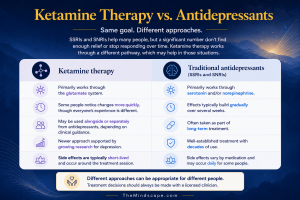 SSRIs and SNRIs work gradually on serotonin and norepinephrine, which is why they take weeks to kick in. Ketamine works on a different system, glutamate, triggering a cascade that raises BDNF and prompts new connections between neurons. That’s why effects can show up in hours or days, and why it can reach people the serotonin route didn’t.
Because anxiety and depression overlap so often, these same brain-change mechanisms are being studied for both. If you’re curious why old patterns feel so hard to shake, this piece breaks down the brain-level reasons. Ketamine also gets lumped in with psychedelics a lot; technically, it isn’t one, and this piece on whether ketamine is a psychedelic clears up the distinction.
Why ketamine treatment for depression can help when standard options fail
Treatment-resistant depression means depression that hasn’t budged after trying two or more antidepressants. Research puts roughly a third of people with depression in this group, a huge number for something that doesn’t get talked about enough.
When the standard route has already been tried and it didn’t work, a treatment working through a different pathway offers something new: a different door into the same room.
Some at-home programs—including Mindscape—use a low-dose, daily approach within the broader sub-anesthetic dose range. Rather than centering treatment around one or two highly immersive sessions, this model emphasizes gradual, cumulative change over time.
At Mindscape, members choose the dose tier and medication format that best fits their goals, and an independent licensed clinician reviews those preferences, confirms what’s clinically appropriate, and can adjust the plan as treatment progresses. That flexibility is designed to let treatment evolve instead of locking everyone into the same protocol.
What are the side effects of ketamine treatment for depression?
The most common effects at therapeutic doses are short-lived and tied to dose: a temporary sense of detachment, dizziness, mild nausea, some perceptual changes, and a brief bump in blood pressure or heart rate. These usually pass within a couple of hours and are monitored by the prescribing clinician.
These effects generally become more noticeable as doses increase. Low-dose approaches are designed to limit exposure to side effects while keeping people connected to everyday life, while still providing therapeutic benefits.
The more serious risks people hear about are tied to high-frequency recreational use at much higher amounts, a completely different context from supervised therapeutic use.
Can you take antidepressants while doing ketamine therapy?
Often, yes. A lot of people stay on their existing antidepressant while doing ketamine therapy. The two are frequently used together rather than as an either-or choice.
Whether to continue, taper, or adjust anything is a clinical call. The prescribing clinician reviews the full medication list for interactions and tracks how things go over time. Nothing changes without that conversation.
 Ketamine therapy and antidepressants aren’t competing for the same job. They work on different parts of the brain and can complement each other depending on what someone needs.
Mindscape supports a daily, low-dose approach to at-home ketamine therapy. Members choose the treatment approach that feels right for them, while independent licensed clinicians make all prescribing decisions, confirm those choices are clinically appropriate, and adjust treatment over time when needed.
Frequently asked questions
Why does ketamine therapy work for some people when antidepressants don’t?
Antidepressants target serotonin and norepinephrine and typically take weeks to work. Ketamine targets glutamate and triggers rapid changes in the brain’s wiring, which is why it can reach people whose depression didn’t respond to the first route.
Can you take antidepressants while doing ketamine therapy?
In many cases, yes. The two are commonly combined. The decision to continue, adjust, or taper is made with the prescribing clinician.
What exactly is ketamine therapy, and why are people using it for depression?
Ketamine therapy uses low, controlled doses of ketamine, delivered by IV, injection, nasal spray, or oral lozenge, to treat depression, anxiety, and related conditions. It’s used because it can act faster than traditional antidepressants and has helped people who didn’t respond to them.
Why can ketamine treatment for depression help when other options fail?
Treatment-resistant depression hasn’t improved after two or more antidepressants. Ketamine works on a different brain pathway than antidepressants do, so it can reach people the standard route didn’t.
This article is for educational purposes and is not medical advice. Treatment decisions should be made with a licensed clinician.
hi