
Depression can affect far more than your mood. It can change how you think, respond to others, and engage with your life. Even when you’re actively working to feel better, familiar thought patterns and emotional reactions can be hard to change.
Ketamine therapy offers a different way to treat depression by supporting the brain’s ability to form new connections involved in mood and learning. Ketamine can be administered in several ways, including as a nasal spray. The dose and frequency of treatment can also shape your experience and results.
Mindscape coordinates with independent licensed providers and pharmacies to offer a personalized, daily low-dose approach to nasal ketamine for depression. Emphasizing consistency over intensity, our protocol is designed to support gradual, sustained improvements in mood, thought patterns, and emotional well-being.
Here’s how daily nasal ketamine works, what the experience may feel like, and how it compares with other treatments. You can also explore our guide to choosing at-home ketamine therapy to compare program options.
What Is Nasal Ketamine?
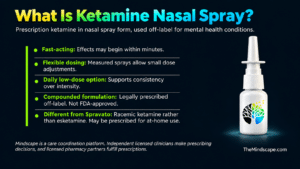
Nasal ketamine, also called intranasal ketamine, is a medication administered through a spray into the nose. It enters the bloodstream through the nasal lining without first passing through the digestive system.
Nasal ketamine for depression typically begins producing noticeable effects within 5 to 10 minutes, compared with approximately 15 to 30 minutes for oral ketamine troches, which are small dissolvable lozenges. The timing varies from person to person.
How Is Compounded Nasal Ketamine Different From Spravato?
Compounding is when a licensed pharmacy prepares medication according to an individual prescription. Compounded ketamine contains racemic ketamine, the full ketamine molecule.
Mindscape’s compounded nasal spray contains racemic ketamine and oxytocin, a hormone involved in social bonding. Compounded nasal ketamine is not FDA-approved, but it may be prescribed for at-home use, including daily low-dose treatment when clinically appropriate.
Spravato is a nasal spray containing one half of the ketamine molecule, known as esketamine. It’s FDA-approved for depression but must be administered in a certified healthcare setting, with at least two hours of monitoring.
How Does a Daily Nasal Ketamine Protocol Work?
Ketamine treatment can follow different schedules. Some approaches use larger doses spaced days or weeks apart, while daily low-dose treatment uses smaller amounts taken more frequently.
Daily Low-Dose vs. Session-Based Ketamine Therapy
Session-based ketamine therapy typically involves larger doses taken during dedicated treatment periods, with days or weeks between treatments. Mindscape’s daily low-dose approach uses smaller doses more frequently, emphasizing consistency over intensity.
You can read more about this model on Mindscape’s Our Approach page.
Daily low-dose treatment may appeal to people who favor an approach that fits into their regular routines. Nasal spray offers additional dosing flexibility because each spray delivers a measured amount of medication. Your prescribing clinician determines an appropriate range of sprays you can take and when, giving you room to adjust within those instructions.
Why Consistency Matters in Low-Dose Ketamine Therapy
Ketamine affects glutamate, a chemical that helps brain cells communicate. This can influence brain activity involved in mood, learning, and the ability to form new connections.
Scientists call the brain’s ability to form and reorganize connections neuroplasticity. It’s one of the ways we learn, adapt, and develop new habits.
For a closer look at the science, read How Ketamine Therapy Supports Neuroplasticity.
The Enhanced Neuroplastic Window
Ketamine therapy can support a period of enhanced neuroplasticity, in which the brain may be more open to learning new ways of thinking and responding.
For example, an ordinary mistake might trigger hours of self-criticism. A disagreement might leave you convinced someone is upset with you, even without evidence. You may know these reactions aren’t helping, but that doesn’t make them easy to change.
During periods of increased neuroplasticity, familiar responses like these may become easier to recognize and work with.
How Repeated Treatment May Support Change
Mindscape’s daily approach is designed to offer repeated opportunities to work with thoughts and emotional reactions that have become automatic over time.
You might feel a shift in negative thought patterns, get less caught up in familiar worries, or find it easier to pause before reacting. These small changes may begin to affect how you handle stress, relate to other people, and make everyday decisions.
The goal is for improvements to extend beyond the time when you’re feeling the medication, helping you become more present and engaged in your life. This is why Mindscape emphasizes consistency over intensity.
What Does Daily Nasal Ketamine Feel Like?
Because nasal ketamine is absorbed quickly, you may begin feeling its effects within several minutes. Some people notice physical relaxation, fewer racing thoughts, or a feeling of distance from their usual worries.
Other effects may include tingling, lightheadedness, dizziness, nausea, or mild dissociation, such as slight visual distortion or a “floaty” feeling. Lower-dose treatment generally aims for a less intense experience than higher-dose approaches.
Your individual experience will depend on your prescribed dose, how your body responds, and other health factors. Plan to avoid driving for at least two hours after taking your medication.
How the Experience May Change Over Time
Side effects like nausea and dizziness often improve after the first few doses. Dissociative effects may become less noticeable as you adjust to the medication. How strongly you feel the medication doesn’t necessarily tell you whether it’s working. Changes in everyday life are where the benefits actually show up.
Perhaps a difficult conversation no longer leaves you replaying every word for hours. You find it easier to begin something you’ve been avoiding, or you feel more interested in spending time with someone you care about.
Improvement may be gradual, and everyone’s timeline is different. For more information, see How Long Does Ketamine Therapy Take to Work?. Talking with your clinician about changes in your mood, daily life, and side effects can help you assess how treatment is going.
How Nasal Ketamine Is Prescribed at Mindscape
Before your consultation, you can select your preferred dose tier and medication form. During your virtual appointment, your clinician reviews your tier and form preferences, health history, current medications, and treatment goals before determining your individual prescription.
An independent pharmacy then prepares and ships your medication right to your door.
Personalized Dosing and Treatment Flexibility
Mindscape’s approach includes:
- Flexible medication forms. Choose your preference for oral troches, nasal spray, or a combination of both. Combination treatment offers the flexibility of nasal dosing alongside the more gradual effects of oral troches.
- Flexible dose tiers. Choose from Ground for a gentle introduction, Flow for more substantial support, or Rise for those seeking a stronger treatment experience.
- Easy treatment adjustments. Request an appointment to discuss changes to your dose or medication form through your Member Portal.
- Ongoing clinical support. Routine check-ins are included at no additional charge, along with two complimentary visits. Additional visits are available for a fee.
For more detail, read How Your Ketamine Dose Is Determined for At-Home Therapy.
Nasal Ketamine vs. Oral Ketamine: What’s the Difference?
Both nasal spray and oral troches can be prescribed for at-home ketamine treatment. They differ mainly in how they’re taken, how quickly they begin working, and how long their effects last.
Nasal Ketamine
Nasal ketamine generally takes effect more quickly, and the noticeable effects may wear off sooner. Nasal spray also offers greater flexibility for fine-tuning very small doses, which can be especially appealing with a daily low-dose approach.
Because Mindscape’s nasal spray also contains oxytocin, a hormone involved in social bonding and emotional responses, it may offer a somewhat different experience from oral troches, which contain ketamine alone.
Oral Ketamine Troches
Oral troches are small lozenges that dissolve beneath your tongue or inside your cheek, allowing the medication to enter your bloodstream through the tissues of your mouth.
Their effects usually begin more gradually and may last longer. Some people prefer the slower experience or find oral medication easier to take.
Research has not established that either form is consistently more effective for depression. Your clinician can help you choose based on your health history, preferences, and treatment goals.
For a closer comparison, read Nasal Ketamine vs. Oral Troches: Which Form Is Right for You?
What Does Research Say About Nasal Ketamine for Depression?
Research is ongoing, but some studies suggest that nasal ketamine can reduce depression symptoms quickly in some people.
In a small study of intranasal ketamine for major depressive disorder, people who received nasal ketamine showed significant improvement in depressive symptoms after 24 hours than those who received a placebo, with few adverse side effects.
What We Know About Daily Low-Dose Ketamine
Most ketamine research has focused on larger doses given less frequently. However, studies of daily low-dose ketamine are showing promising results for depression, and research is ongoing. A 2023 review of oral ketamine studies found encouraging results across a range of dosing schedules, including daily treatment.
Mindscape’s approach builds on this emerging evidence and ketamine’s effects on neuroplasticity, with the goal of supporting gradual, lasting improvements through consistent treatment.
Is Daily Nasal Ketamine Right for You?
Your treatment goals, health history, current medications, previous treatment experiences, and daily circumstances all help determine whether it’s appropriate.
With Mindscape, you can choose your preferred dose level and medication form, including nasal spray, oral troches, or a combination. Your clinician reviews your preferences and health history to determine the appropriate treatment and dose.
Explore Mindscape’s membership and treatment options or start your personalized assessment.
Frequently Asked Questions About Nasal Ketamine for Depression
Does nasal ketamine help depression?
Nasal ketamine may reduce depression symptoms in some people. Small studies have found improvements within 24 hours of treatment. However, compounded nasal ketamine has been studied less extensively than FDA-approved esketamine, and results vary.
Can you take nasal ketamine daily for depression?
Yes. A licensed clinician may prescribe smaller daily doses of nasal ketamine when appropriate. Your clinician determines how much medication you take and how often.
How long does nasal ketamine take to work for depression?
You may feel the medication within 5 to 10 minutes, but improvement in depression can take longer. Some studies have found improvement within 24 hours after a single treatment.
Is nasal ketamine better than oral ketamine for depression?
Neither form has been proven consistently more effective. Nasal ketamine usually takes effect faster, while oral troches produce a more gradual experience. Your clinician can help determine which is appropriate for you.
Is compounded nasal ketamine the same as Spravato?
No. Spravato contains FDA-approved esketamine and must be taken in a certified healthcare setting. Compounded nasal ketamine contains racemic ketamine and may be prescribed for use at home, but it is not FDA-approved for depression.
Can nasal ketamine help anxiety as well as depression?
Ketamine has also been studied for anxiety, and some people receiving depression treatment may notice improvements in anxiety symptoms. However, evidence for compounded ketamine in treating anxiety disorders remains limited, and it is not FDA-approved for anxiety.
Does Mindscape offer at-home nasal ketamine for depression?
Yes. Mindscape connects eligible members with independent licensed clinicians who may prescribe compounded nasal ketamine, including daily low-dose options. Independent pharmacies fill prescriptions, and members have access to ongoing clinical oversight, including required check-ins before prescription renewals.
Can my nasal ketamine dose be adjusted?
Yes. Your prescribing clinician may change your dose, dosing range, or medication form based on your needs and response. All changes require clinician approval. Never exceed your prescribed dose or change your schedule without medical guidance.
hi