

No two people respond to ketamine therapy in exactly the same way. What feels subtle for one person may feel significant for another. What works well at the beginning of treatment may not be what works best a few months later.
That’s why dosing isn’t just about where you start. It’s also about whether treatment can adapt as your needs, goals, and responses become clearer.
At Mindscape, dosing is built to be responsive. Three tiers, two delivery forms, member input at every stage, and a licensed clinician who reviews any change before it happens. If you’re curious about what a ketamine session actually feels like, this guide walks you through that experience.
Here, we break down how dosing works, when it can change, and who makes those decisions.
How Does Dosing Work in At-Home Ketamine Therapy?
A low-dose daily protocol uses a smaller amount of ketamine taken on a regular daily cadence under clinician direction, as distinct from intensive short-course or bolus models that concentrate larger amounts into a few supervised treatments.
The difference matters more than it might seem. IV ketamine is built around a handful of high-dose sessions designed to produce a significant shift in one go. The daily low-dose model does something different:
- Smaller amounts, taken consistently, building a cumulative effect over weeks and months.
- No single session that makes or breaks the outcome.
- Change that shows up gradually, in sleep, in reactivity, in how familiar stress lands.
Think of it less like a course of antibiotics and more like physical therapy. The change comes from showing up regularly, not from one intense session.
The mechanism here is repetition. Each session opens a window of increased neural receptivity, during which there’s an opportunity to practice a different response. Across days and weeks, the nervous system starts to respond differently to the same triggers. Not because something dramatic happened once, but because something steady happened consistently. Mindscape members often describe this as a gradual shift in their baseline that builds until something clearly feels different.
What Does a Session Look Like Day to Day?
You take your dose at home, at a time that fits your schedule. Most members dose in the morning or evening, in a quiet space, lying down or seated comfortably. Our low-dose vs high-dose comparison post covers the mechanistic differences in detail. Here’s the short version of what each tier feels like per session:
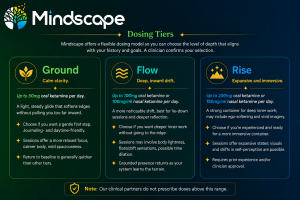
- Ground: subtle to imperceptible effect. Many members notice very little per session, which surprises them.
- Flow: a noticeable but manageable shift. A quieting of mental noise, mild lightheadedness, a loosening of the usual background tension.
- Rise: more pronounced per session. Recovery takes longer. Not where most members start, and not the goal by itself.
There’s no required activity during a session. No guided visualization, no journaling protocol. Most people just rest quietly. Some put on music. That’s genuinely it.
Can the Dose Be Adjusted Over Time?
Yes. And it’s one of the questions many people have when they’re deciding whether a program is the right fit.
At Mindscape, adjustments are member-initiated and clinician-directed. If your current tier isn’t producing the response you expected, or if you feel ready to step up, you request a review through your member portal. Your clinician looks at what you’ve reported and what makes clinical sense before approving anything.
No tier change happens without clinical input. This ensures adjustments are safe and meaningful.
What Triggers a Dose Adjustment?
There are a few common patterns:
- The current tier isn’t doing much. Sessions feel completely neutral. Nothing is shifting in sleep, reactivity, or baseline mood after several weeks. Worth bringing to your clinician.
- The tier is too much. Someone moves to Flow and finds the session experience harder to manage than expected. Stepping back to Ground isn’t a failure. It’s the protocol working as designed.
- Life circumstances shift. Stress rises, something changes, a period of improvement suddenly stalls. These aren’t reasons to push through alone.
- The need for support changes. Some members find that as they feel more regulated, present, and settled in daily life, they no longer need the same level of support they did when they started. A lower tier can be just as appropriate as a higher one.
The two complimentary clinician visits within your first 180 days make it easy to have a real clinical conversation about what’s working and what isn’t.
What Are the Ground, Flow, and Rise Tiers, and How Do You Choose a Form?
Mindscape offers three tiers and two delivery forms. You choose both, with your clinician confirming the selection fits your situation.
What Each Tier Actually Feels Like
Ground is often the most surprising tier. The perceptual effect per session is minimal, sometimes nothing at all. But the cumulative effect builds quietly. Changes in sleep and reactivity often show up before any obvious session effect does.
Flow is where many members settle for a significant stretch. There’s a real shift per session: a quieting of mental noise, mild lightheadedness, a loosening of the usual background tension. You’re aware throughout. You could hold a conversation if you needed to.
Rise produces the strongest effects of the three tiers. Recovery tends to take longer, and the experience is often more immersive than Ground or Flow. It’s the upper end of the low-dose range, not where most members begin.
On the Two Delivery Forms
- Oral lozenges (troches and ODTs): dissolve slowly, producing a gradual build with a longer active window. Most common starting point.
- Nasal spray: faster onset, shorter arc. Some members prefer it for scheduling reasons. Not available in all states; your portal will show what’s available to you.
Learn more about Mindscape membership and pricing.
What Are the Side Effects of Low-Dose Ketamine?
Low-dose ketamine side effects are generally mild and dose-dependent. At Ground, most members notice very little. At Flow and Rise, the most common effects include:
- Mild lightheadedness
- A floaty or dreamy quality during the active window
- Slight perceptual changes
- Occasional nausea in the first few sessions, which typically settles quickly
What the acclimation arc tends to look like in practice:
- First week: the most variable. Some members notice effects more strongly. Some notice very little.
- Weeks two to four: effects become more predictable and easier to work with.
- Month two onward: sessions often feel subtler, even at the same dose. This doesn’t necessarily mean the treatment is becoming less effective. For many people, the experience becomes less novel over time even as benefits continue to build.
These effects are meaningfully different from the side effect profile of IV or higher-dose protocols. The full safety and side effects guide covers what to watch for and when to contact your clinician.
One rule at every tier: don’t drive for at least two hours after dosing, or until you’re fully back to baseline.
What About People Who Haven’t Responded to Antidepressants?
A lot of people who come to Mindscape have already been through the standard options. SSRIs, SNRIs, therapy, the slow cycle of trying something for six weeks, deciding it isn’t working, and starting over.
This is worth naming directly because ketamine’s mechanism is genuinely different from everything in that stack.
- SSRIs and SNRIs work on the monoamine system, targeting serotonin and norepinephrine.
- Ketamine works on the glutamate system, specifically through NMDA receptor activity, which drives rapid changes in synaptic plasticity.
It’s not a stronger version of what came before. It’s a different pathway entirely. The daily low-dose model is designed to leverage that pathway through consistent use, not through a single high-intensity session. That’s why it tends to suit people who want treatment that fits around their lives, not treatment that requires their lives to stop.
Is Sublingual Ketamine as Effective as IV?
It depends on what you mean by effective.
IV ketamine delivers near-100% bioavailability directly into the bloodstream. Per session, it’s more concentrated and produces a more intense effect.
Sublingual ketamine, taken daily at low doses, works on a different timeline entirely. Smaller amounts, higher frequency, cumulative change. Research on glutamate pathway modulation supports that both mechanisms can produce meaningful clinical outcomes.
There’s also a practical dimension most comparisons skip:
- IV ketamine requires clinic visits, scheduling, and transportation home afterward.
- At-home sublingual fits into a morning or evening without disrupting the day.
- A treatment you can fit into a daily routine has a different kind of effectiveness than one that requires scheduling your week around it.
One isn’t universally better. The right model depends on the person’s goals, their history with ketamine therapy, and the role they want treatment to play in their day-to-day life.
Comparing ketamine therapy programs before deciding? Our comprehensive guide covers at-home providers side by side, including dosing models, clinician involvement, and pricing. Built for people who want the full picture before committing to anything.
Ready to see if Mindscape is a fit? Take our 2-minute Clarity Quiz to get started.
Frequently Asked Questions
How Much Control Do I Actually Have Over My Dose?
More than most people expect, within a clinical structure. You choose your starting tier and form, and can request adjustments any time through your portal. Your clinician reviews each request before anything changes.
Is a Licensed Clinician Actually Involved, or Is It Mostly Automated?
A licensed clinician is involved at every stage that matters: initial evaluation, any tier or form change, your six-month prescription renewal, and any additional visits you request. Clinical decisions belong to the clinician. The platform handles coordination.
Is Sublingual Ketamine as Effective as IV?
Per session, IV delivers higher bioavailability and a more concentrated effect. Sublingual low-dose ketamine taken daily works differently: smaller amounts, higher frequency, cumulative change. The better question is which model fits the person using it.
Is Ketamine Microdosing the Same as a Low-Dose Daily Protocol?
Ketamine microdosing, meaning taking sub-perceptual doses where the session produces little noticeable effect, describes Mindscape’s Ground tier specifically. But a low-dose daily protocol also includes Flow and Rise, where sessions produce a real effect. The defining feature isn’t a single dose level. It’s daily cadence and clinician direction throughout.
hi