

Looking at anxiety through the lens of the nervous system helps explain why some treatments work differently than others. Ketamine treatment for anxiety can help reduce anxious thoughts, but it may also create conditions in which long-standing protective patterns become more flexible. That can make it easier to change long-standing responses that once happened automatically, supporting a greater sense of calm and ease over time.
When people think about anxiety, they often imagine excessive worrying. Overthinking is a big part of anxiety, but for many people, it goes deeper than that. It shows up as constant tension, hypervigilance, or a feeling that you can never fully relax.
Over time, that constant state of alertness can affect almost every part of your life. It becomes harder to be fully present with the people you care about, to focus at work, or to enjoy moments that should feel peaceful.
What Anxiety Feels Like Day to Day
Maybe you get a knot in your stomach every time the phone rings. You hold your breath more often than you realize. Your shoulders stay tense for most of the day. You check things over and over to make sure you didn’t forget anything. Your heart starts racing the moment someone says, “Can we talk?” By the end of the day, you’re exhausted, even though nothing particularly dramatic happened.
These moments can seem too ordinary to notice, but they add up. You begin saying no to things you’d like to do. You put off difficult conversations. You spend more time trying to prevent problems than enjoying the moments when everything is actually okay.
Signs of a Dysregulated Nervous System
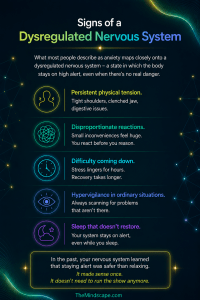 What most people describe as anxiety maps closely onto what researchers and clinicians call a dysregulated nervous system: a state in which the threat-detection circuitry becomes oversensitive, firing responses that were originally designed for acute danger in situations that don’t warrant them.
Some of the clearest signs:
- Persistent physical tension. Shoulders that won’t drop, a clenched jaw, digestive issues. Not because anything specific is wrong, but because the body is primed.
- Disproportionate reactions. A small inconvenience lands like a crisis. An ambiguous message reads as hostile. The emotional response arrives before the reasoning does.
- Difficulty coming down. Something stressful happens, and hours later the system still hasn’t settled. Recovery takes longer than it should.
- Hypervigilance in ordinary situations. Scanning for problems before there’s evidence of any. Preparing for conflict that doesn’t materialize.
- Sleep that doesn’t restore. Even during sleep, your system doesn’t fully switch off. The alertness follows you, so you never feel fully rested.
None of this means something is fundamentally wrong with you. It means your nervous system learned, at some point, that staying alert was safer than relaxing. The old programming running underneath anxiety isn’t random. It made sense once. The problem is that it kept running long past the circumstances that created it.
Regulating the Nervous System: What That Actually Means
Regulating the nervous system is not the same as managing anxiety symptoms. Symptom management tends to work at the surface level: you use a technique, the anxiety drops; stop doing the technique, the anxiety returns. That’s a maintenance approach, but it doesn’t change your baseline.
Nervous system regulation is a deeper change. It means the resting state of the system shifts. The high level of activation comes down. Recovery from stressful events gets faster. The automatic threat-detection response becomes less trigger-happy, not because you’ve learned to reason with it, but because something at a neurobiological level has updated.
This is where the research on ketamine for anxiety gets interesting. Ketamine works differently from many traditional medications. It acts on the brain’s glutamate system, helping create an enhanced neuroplastic window: a period when the brain is more open to change. During that time, long-standing patterns can become more flexible, making them easier to work with.
What the Research on Ketamine for Anxiety Shows
The research on ketamine treatment for anxiety is still developing, but the findings so far are encouraging. Studies have shown that ketamine can reduce symptoms of generalized anxiety disorder and social anxiety disorder, including in some people who hadn’t found enough relief with conventional treatments.
Researchers have also found that ketamine may reduce anxiety in people with treatment-resistant anxiety disorders, although most of the research so far has focused on IV ketamine rather than oral or nasal approaches.
A meta-analysis also found that anxiety symptoms can improve within hours of treatment, and that those improvements weren’t linked to the intensity of dissociation. In other words, a more intense experience doesn’t necessarily lead to better results. That’s particularly relevant for daily low-dose protocols, where the dissociative effect per session is modest by design.
How Ketamine Treatment for Anxiety Works in a Low-Dose Daily Protocol
 This is where Mindscape’s approach differs from the IV clinic or intensive short-course model. For a fuller comparison, low-dose vs high-dose ketamine breaks down how the two work differently. The short version: intensive protocols front-load change into a small number of high-dose sessions. A daily low-dose protocol does something different.
Rather than producing a single significant experience and hoping the change holds, daily low-dose ketamine creates repeated, low-key opportunities for the nervous system to engage with a more regulated state. Over weeks and months, the cumulative effect may include a less activated state in which old anxiety patterns have less grip, and recovery from stressful events gets faster.
The neuroplastic window that each low-dose session opens supports this. The brain becomes more receptive to new patterns during and after dosing—so how you engage mentally and emotionally with the sessions matters alongside the medication itself.
Dosing in the Mindscape model is collaborative. The starting tier and any adjustments are shaped with input from the individual, with a clinician confirming what makes sense given how the protocol is working. It’s not one-size-fits-all.
If you’re weighing your options, our comprehensive guide covers how at-home programs compare, the evidence base at different dose levels, and what to look for in a program. It’s a useful starting point before making any decisions.
Frequently Asked Questions
How does ketamine treatment for anxiety work?
Ketamine works on the glutamate system to encourage a temporary window of increased neuroplasticity. For anxiety, the effect appears to work on hyperactive threat-detection responses that keep the nervous system in a state of chronic alert.
How effective is ketamine therapy for anxiety compared to traditional meds?
Direct comparisons are hard because the research designs differ significantly. What the studies consistently show is that ketamine produces anxiety reductions in people who haven’t responded to SSRIs, often within hours rather than weeks.
Is there a ketamine success rate for anxiety?
There’s no single number that holds across anxiety types, delivery methods, and individual presentations. The more useful frame is: is the chronic background tension shifting? Is recovery from stress getting faster? Those are the real signals.
hi