

Something about ketamine therapy caught your attention: how differently it works, how quickly some people notice a shift, or the possibility of another option when standard care has not helped enough. The practical question is simple: who is a good candidate for ketamine therapy?
Ketamine therapy is often explored by people navigating a range of mental health-related symptoms. Some have tried therapy or medication without enough relief. Others are still functioning, but feel stuck in patterns of worry, numbness, hypervigilance, disconnection, or overwhelm. Mindscape’s recent article about ketamine and neuroplasticity explains how it can create a temporary period in which established patterns become more flexible and easier to work with.
Candidacy is not defined by one diagnosis or a single checklist. It depends on what you are experiencing, what you have already tried, your health history, and whether a clinician believes ketamine is safe and appropriate for you.
Who Is a Good Candidate for Ketamine Therapy?
Signs to Look For:
There is no single profile that defines a good candidate. Still, a few patterns often lead people to explore ketamine therapy.
Your Depression or Anxiety Hasn’t Shifted Enough
One of the clearest signs is that you have made a real effort, but your symptoms have not improved enough or the relief has not lasted.
This may look like:
- Therapy or medication helped only partially
- Improvement faded and familiar symptoms returned
- Anxiety, low mood, or emotional numbness still interferes with work, relationships, rest, or ordinary moments
The same can apply when anxiety and depression overlap, or when one condition keeps feeding the other.
You Feel Stuck in Stress, Burnout, or Trauma-Related Patterns
Not everyone considering ketamine describes their experience as depression. Some feel chronically on edge, emotionally depleted, disconnected from themselves, or unable to recover after stress. Others notice PTSD-related hypervigilance, avoidance, or a nervous system that rarely feels safe enough to settle.
You may recognize patterns such as:
- Constant tension, overthinking, or a sense that your mind never fully switches off
- Burnout-like exhaustion that does not resolve with a weekend, a vacation, or more sleep
- Avoidance, emotional shutdown, or reactions that feel much bigger than the immediate situation
Burnout itself is not a medical diagnosis, so a clinician will look beneath the label and consider whether anxiety, depression, trauma-related symptoms, chronic stress, or another condition may be contributing.
You See Yourself in “Functional Depression”
Some people keep meeting responsibilities while quietly experiencing low mood, fatigue, disconnection, or loss of interest. This is often called functional depression.
Common signs include feeling emotionally flat, needing extra effort to stay productive, and moving through the day on autopilot. Although it is not a formal diagnosis, understanding what functional depression can look like may help you recognize and describe symptoms others cannot see.
The Usual Approaches Haven’t Been Enough
Ketamine therapy tends to come up when there’s a real gap between the effort you’ve put in and what you’ve gotten back.
This can look like:
- Treatments that worked temporarily but stopped being effective
- Partial improvement without full symptom relief
- Multiple approaches that didn’t lead to meaningful change
That pattern can be a sign that standard treatments, which mostly work through serotonin, aren’t reaching everything that’s going on.
Ketamine works differently. It acts on the glutamate system and creates a temporary window of neuroplasticity, sometimes described as an enhanced neuroplastic window, a period where the brain becomes more open to change and established patterns are easier to work with.
Who Probably Is Not a Good Fit for Ketamine Therapy
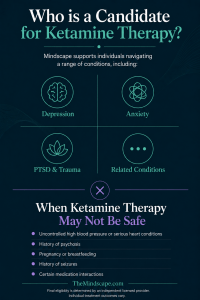 Ketamine therapy is generally not recommended in the following situations:
- You have uncontrolled cardiovascular issues.
Ketamine can raise blood pressure and heart rate for a short while. If your heart condition isn’t stable or managed yet, that’s a risk worth addressing before anything else.
- You have a history of psychosis or are currently experiencing psychotic symptoms.
Ketamine briefly changes perception and awareness. Most people handle that fine. For someone with a history of psychosis, though, it can be destabilizing, which is exactly why clinicians are careful here.
- You’re dealing with active, untreated substance use.
A past history alone won’t automatically rule you out. But active, untreated use can affect both your safety and how well treatment works, so getting stable is usually the first step.
- You are pregnant or nursing.
There isn’t enough reliable data on safety during pregnancy or while nursing, so ketamine is generally avoided in these cases.
How Mindscape’s Assessment Process Works
At Mindscape, your assessment is designed to make sure ketamine is both appropriate and tailored to your needs. It begins with an initial screening and your treatment preferences, then an independent licensed provider reviews your health history, symptoms, goals, and choices to determine whether ketamine is a good fit and where to begin.
Step 1: Complete the intake and choose your preferences
You begin with our 2-minute Clarity Quiz that screens for important safety considerations and helps identify whether ketamine may be appropriate for you. You’ll also select the treatment tier that feels closest to the experience you’re looking for—Ground, Flow, or Rise—and choose an oral option, a nasal option, or a combination. These are preferences, not prescriptions, and every selection is subject to clinician approval.
Step 2: Meet with an independent licensed provider
During your virtual consultation, the provider reviews your symptoms, health history, previous treatments, medication sensitivities, goals, and prior experience with ketamine. This is also your opportunity to ask questions and talk about what you hope will feel different in your daily life.
Step 3: Confirm safety and the right starting fit
If ketamine is appropriate for you, the provider confirms whether your preferred treatment tier and medication form are the right place to begin. They may recommend a different starting point based on your health history, safety considerations, and clinical judgment.
Step 4: Your Treatment Can Evolve
Your treatment begins with the tier and medication form that make the most sense today. As your needs change over time, you can work with your clinician to adjust your treatment so it continues to fit your life.
Step 5: Leave with clear next steps
By the end of your assessment, you’ll know whether you’re eligible to begin treatment, whether a different starting option is recommended, or whether ketamine isn’t the right fit for you at this time.
Low-Dose vs. Short-Course, Higher-Dose Ketamine Protocols
Ketamine therapy can follow different treatment approaches, and those approaches shape the experience.
Short-course, higher-dose protocols usually concentrate treatment into a limited number of IV infusions or higher-dose sessions. They are often built around more intensive individual experiences, with more noticeable dissociation and more recovery time around each treatment.
 Mindscape uses a consistent at-home approach with oral lozenges, nasal spray, or a combination, as approved by the treating clinician. Rather than placing most of the emphasis on a small number of peak sessions, the approach is designed to support repeated opportunities for nervous-system regulation, reflection, and integration into ordinary life.
When comparing low-dose care with short-course, higher-dose protocols, the main difference is not simply the amount used. It is how treatment is structured and what the approach is designed to support.
- Short-course, higher-dose care concentrates treatment into a limited number of more intensive sessions
- Mindscape’s approach prioritizes consistency, adaptable tiers and forms, and integration into daily life
Mindscape’s protocol is designed around consistency. Repeated contact with a more regulated internal state may make it easier to bring new responses into relationships, work, parenting, rest, and other parts of everyday life. You can read more about our approach or explore our comprehensive guide to see how different ketamine therapy programs compare.
Ready to see if ketamine therapy is a fit? Take our Clarity Quiz to get started.
Frequently Asked Questions
Who is a good candidate for ketamine therapy?
A potential candidate may be dealing with depression, anxiety, PTSD symptoms, chronic stress, functional depression, or burnout-like exhaustion that has not improved enough with standard support. The final decision depends on treatment history, health, current symptoms, and a clinician’s assessment.
Who should not try ketamine therapy?
Ketamine may not be appropriate for people with uncontrolled high blood pressure or serious heart problems, psychosis or mania symptoms, active untreated substance use, pregnancy or nursing, certain other medical contraindications, or anyone whose current treatment is already working well. A licensed clinician must determine eligibility.
How do I know if ketamine therapy is right for me?
Look at four things together: what you are experiencing, what you have already tried, whether your health history allows ketamine to be used safely, and whether a consistent at-home approach fits your goals. At Mindscape, you choose a preferred tier and form, then an independent clinician confirms or adjusts that choice to create the safest and most appropriate fit.
Is ketamine therapy safe for people with anxiety and depression?
For many eligible people, ketamine can be used safely under the guidance of an independent licensed clinician. Ketamine is not appropriate for everyone, and it should only be taken as directed.
hi