

Overthinking and low mood often show up together. The more your mind loops through the same worries, memories, or what-ifs, the harder it becomes to break out of those patterns. Over time, it becomes more difficult to move out of negative emotions. Looking at the connection between glutamate and depression helps explain why.
When mood regulation is discussed, serotonin and dopamine tend to get the most attention. Those neurotransmitters are important, but they’re only part of the picture. Glutamate offers another perspective, helping explain how the brain processes information, forms connections, and sometimes becomes stuck in repetitive patterns.
Glutamate is the brain’s primary excitatory neurotransmitter. It helps brain cells communicate, learn, and adapt. It’s also one of the reasons ketamine has generated so much interest as a treatment for depression. Understanding glutamate’s role can help explain why overthinking and low mood often go hand in hand, and why ketamine works so differently from traditional antidepressants.
What Is Glutamate?
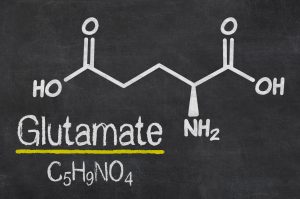 Glutamate is the brain’s main excitatory neurotransmitter, the chemical messenger neurons use to get each other to fire and pass information along. It isn’t just involved in a few brain functions. Glutamate is everywhere, with an estimated 80 to 90 percent of the synapses in your brain using it to communicate.
Glutamate is directly involved every time you:
- Learn something new
- Recall a memory
- Form a thought
It’s also one of the primary drivers of neuroplasticity, the brain’s ability to strengthen and reorganize connections over time. Glutamate is one of the primary drivers of that process.
Every time certain groups of neurons fire together, the connections between them can become stronger, making those pathways easier for the brain to use again. That’s how a new skill becomes automatic, a memory becomes easier to recall. And, less helpfully, how a recurring thought-pattern can become so well established that it starts feeling automatic too.
The Link Between Glutamate and Depression
Because glutamate is so central to how connections form and strengthen, disruptions to its signaling don’t just influence mood. They can also affect the brain’s ability to adapt, update, and shift established patterns.
Research has found that chronic stress and depression are associated with changes in glutamate signaling, particularly in two regions: the prefrontal cortex and the hippocampus.
Both areas are tied to:
- Mood regulation
- Memory
- Decision-making
Some of that research points to fewer synaptic connections in these areas, reducing flexibility in the brain networks responsible for attention and mood. In other words, it’s harder to shift negative emotional and thought patterns once they’re established.
That’s not the same as simply having “too little” glutamate. Disrupted signaling isn’t simply about quantity. It could involve reduced connectivity in one circuit and excess activity in another, depending on the person and the kind of stress involved.
In practice, this can look like a brain that’s better at reinforcing existing patterns than creating new ones. That’s one reason negative thought loops can be so difficult to interrupt through willpower alone.
If you’ve ever wondered why it’s so hard to simply stop following negative thought loops, here’s why your brain keeps overthinking everything.
Why Glutamate Is Different From Serotonin, and Why Ketamine Works Differently Than SSRIs
Serotonin features heavily in conversations about depression, largely because SSRIs (selective serotonin reuptake inhibitors) are the most commonly prescribed antidepressants. Glutamate plays a fundamentally different role in the brain, which is one reason ketamine works differently from traditional antidepressants.
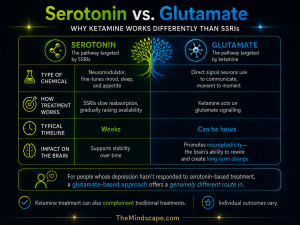
Neither system is “better” than the other. They’re addressing different parts of the problem. For people whose depression hasn’t responded to serotonin-based treatment, a glutamate-based approach offers a genuinely different route in, rather than another version of the same treatment.
How Ketamine Affects Glutamate Signaling
At the doses used in ketamine therapy, ketamine blocks a specific type of glutamate receptor called the NMDA receptor, including some receptors located on the neurons that normally help keep glutamate release in check. With that regulation temporarily loosened, a cascade follows:
- A surge of glutamate activates a different receptor type, called AMPA receptors, ramping up activity in key brain regions
- That activity triggers the release of BDNF (brain-derived neurotrophic factor), a protein that supports the growth of new neural connections
- New connections between neurons become easier to form, a process related to what researchers call synaptogenesis
The result is a temporary window of enhanced neuroplasticity when the brain is measurably more open to forming new connections and updating old patterns.
The window itself doesn’t do the work of change. It primes the brain’s environment to be receptive to change. It’s a bit like preparing soil to receive a seed, rather than planting the seed itself.
A negative thought loop often keeps running because the brain has gotten very good at firing that specific pattern, almost on autopilot. The neuroplastic window ketamine opens is, at least in theory, a chance to interrupt that autopilot and let a different pattern take hold instead.
Glutamate and Depression: An Evolving Picture
Glutamate and depression remain an active area of research. Their connection helps explain some aspects of how the brain becomes stuck in persistent patterns, but it isn’t the whole story.
Depression is influenced by many factors, including:
- Genetics
- Life experiences
- Other neurotransmitter systems
- Physical health
- Environment
- Many biological processes researchers are still working to understand
No single brain chemical can fully explain why one person develops depression or why symptoms look different from one individual to the next.
What research on glutamate does offer is a clearer understanding of why ketamine works differently from traditional antidepressants. By targeting glutamate signaling and promoting neuroplasticity, ketamine may help the brain form new connections rather than simply reinforcing old ones.
If you’re exploring ketamine therapy, understanding the science is just one part of the decision. This program guide helps you compare at-home providers, while our Approach page dives into Mindscape’s unique, daily, low-dose protocol.
Ready to see if ketamine therapy is a fit for you? Take our 2-minute Clarity Quiz to get started.
Frequently Asked Questions
What does glutamate do in the brain?
It’s the brain’s main excitatory neurotransmitter, the primary signal neurons use to communicate. It plays a central role in learning, memory, and how the brain builds new connections.
Is glutamate the same thing as serotonin?
No. Glutamate is a fast-acting signal used for direct neuron-to-neuron communication. Serotonin is more of a neuromodulator, fine-tuning mood and other systems gradually.
Can low glutamate cause depression?
It’s less about glutamate being “low” and more about disrupted signaling, sometimes too little activity in one area, sometimes too much in another.
How does ketamine affect glutamate?
It blocks NMDA receptors, which sets off a glutamate surge and a cascade that includes BDNF release. Researchers believe this opens a temporary window of increased neuroplasticity.
Does glutamate have anything to do with overthinking?
Possibly, at least indirectly. Since glutamate helps the brain reinforce patterns, disrupted signaling may make it harder to interrupt patterns that are already well established, including looping thoughts.
hi