

The first Mental Illness Awareness Week was observed in October 1990. Attitudes around mental health have improved since then, but several barriers still prevent people from getting support. One of them is uncertainty: you may know something feels wrong without knowing what it could point to. It can be hard to tell whether you’re dealing with burnout vs depression, anxiety, or something else.
These conditions are separate, but their symptoms can overlap, and each one can feel different from person to person. Whatever the cause, those symptoms can affect your sleep, work, and relationships.
Understanding what burnout, depression, and anxiety feel like can be more helpful than studying a list of criteria. This guide explains them in plain language to help you put words to what’s going on and consider whether to take steps to address it.
Describing Your Own Experience
Is it tricky to explain your experience beyond simply “feeling off”? Maybe you know something has changed, but when you try to explain it, you can’t find the right words, or the ones you find make it sound minor: tired, busy, stressed. You might not have said much about it to anyone, including yourself.
Putting words to what’s been going on can help you see if it needs closer attention. These questions can help you get more specific:
- What’s hardest right now? Keeping up with everything that’s expected of you, finding the energy or reason to do much of anything, or getting your mind to stop worrying?
- Which words best describe your mood lately? Resentful or detached, sad or empty, or tense and uneasy?
- What do you find yourself thinking? That your effort doesn’t make a difference, that you’re worthless or to blame, or that something is about to go wrong?
- What happens when you get a real break? Do you start to get back to normal, does nothing change, or do you spend it worrying?
- What about the parts of your life outside of work and obligations? Do you still enjoy them, have they lost their interest too, or is it hard to enjoy them because your mind is somewhere else?
Your answers aren’t a diagnosis, and there’s no right or wrong way to answer. Keep them in mind as you read the next sections on burnout, depression, and anxiety, and notice which descriptions sound familiar. You can also talk them over with someone you trust, or bring them to a professional if you decide to.
Burnout vs Depression: Is It One or Both?
Burnout and depression can look alike, both to you and to the people around you. Both can leave you exhausted, unmotivated, and struggling to concentrate or sleep. Depression can make work feel overwhelming in a way that mimics burnout, and burnout that goes on for a long time can lead to depression.
Knowing the signs of burnout vs depression can help you see whether one matches your experience better or if both do.
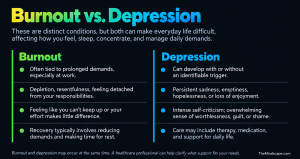
Could It Be Anxiety?
Anxiety isn’t only worry. It can show up as overthinking every scenario, trying to manage most situations, or avoiding anything that might go badly.
It might feel like you’re just being organized and responsible, but there can be an underlying sense of danger driving it. That can lead to controlling behavior, irritability, or trouble relaxing, even when things are going fine. Anxiety often leaves you emotionally exhausted, because there’s always something to prepare for, and your nervous system reacts to everyday problems like an emergency.
Other ways anxiety can show up:
- Checking and seeking reassurance: You reread an email after sending it, double-check that the door is locked, or ask people whether everything is okay between you.
- Replaying conversations: Hours or days later, you go back over what you said, looking for what you might have gotten wrong.
- Perfectionism: It’s hard to call something finished, so you keep redoing work that’s already good enough.
- Trouble making decisions: Small choices take longer than they should because you’re weighing what could go wrong with each option.
- Physical symptoms: Stomach problems, headaches, tight shoulders or jaw, a racing heart, or shallow breathing.
- Sleep problems: You’re tired but can’t fall asleep, or you wake up in the middle of the night thinking about the next day.
Some worry is a normal part of life, but if these patterns happen often or get in the way of things you care about, it may be more than everyday stress.
Pros and Cons of a Mental Health Diagnosis
You don’t need a diagnosis to try self-care steps or to get professional support, though some people find one helpful. If you’re considering an assessment, it helps to understand the potential benefits and limitations of a diagnosis.
Pros
A diagnosis can connect problems that seem unrelated and help you stop blaming yourself. Trouble concentrating, for example, can be part of depression, not a sign that you aren’t trying. Knowing that can ease a lot of shame.
It gives you and your clinician a starting point for planning treatment. You may also need documentation for insurance, certain services, or accommodations at work or school.
Cons
A diagnosis won’t explain every difficulty or tell you exactly which treatment will work. People with the same diagnosis can need different care.
It also doesn’t predict your future. Thoughts like “I have depression, so I’ll never have a good relationship” or “I can’t be the parent I want to be” aren’t supported by a diagnosis. It’s information about your health, not about what you can and can’t expect from life.
How Do I Know If I Should Talk to Someone?
 If you think talking to someone might help, you don’t need to meet to know if it’s burnout vs. depression or anxiety, or something else. If you’ve been feeling this way for months or longer, talking to someone, like your primary care doctor or a therapist, can help you understand what’s going on and figure out what might help.
Getting professional support isn’t a sign of weakness or failure. It shows you’re taking your health seriously, for yourself and for the people who count on you.
If you’re not ready to reach out right now, keep checking in with yourself. Come back to the questions above, notice whether things are getting better or worse, and keep track of what helps.
If you’re having thoughts of suicide or self-harm, get support right away. Call or text 988 to reach the Suicide & Crisis Lifeline in the U.S., or call 911 if you’re in immediate danger.
Finding Support That Fits
Care is available in person and online. Your health history, preferences, budget, and schedule can help you decide what fits.
- Mental health screening: Mental Health America offers free screenings that can help you identify symptoms to discuss with a professional. A screening isn’t a diagnosis.
- Primary care: A PCP can check for mental and physical causes, discuss treatment, prescribe medications such as antidepressants when appropriate, and refer you to a specialist.
- Therapy: There are many approaches to talk therapy, and people respond differently to each. Cognitive behavioral therapy (CBT) focuses on patterns of thinking and behavior, while Internal Family Systems (IFS) works with different parts of yourself, like a harsh inner critic. A consultation lets you ask whether a therapist’s approach fits your needs. Other techniques like EMDR and neurofeedback may help shift negative thought loops and associations.
- Psychiatric care: A psychiatrist can assess symptoms and discuss medication options, including benefits, side effects, and alternatives.
- Ketamine therapy: For some people, ketamine may help loosen repetitive negative thought patterns, especially when other treatments haven’t helped with depression. Treatment starts with an assessment by a licensed provider.
- Mindfulness: Research suggests regular mindfulness practice may ease symptoms of anxiety and depression, and it’s something you can practice on your own, through apps, short guided sessions, or a class. It can help you notice negative thoughts and worries as they come up, without automatically reacting to them.
- Burnout self-care and practical support: Recovery may involve more sleep and breaks, a lighter workload, shared responsibilities, or changed expectations. If things don’t improve, clinical support is an option.
If something isn’t helping, ask your provider when you’ll review your progress and what else you could try. You may need an adjustment, a different approach, or a different clinician.
Where to Go From Here
Whether it’s burnout vs. depression, anxiety, or none of these, what you’re going through is real. Putting words to it is a step forward, even if you keep those words to yourself for now. If you do decide to reach out, it can help to think about what you’re hoping for, like enjoying time with your family again, being able to focus, or getting a break from constant worry or self-criticism. A good clinician will take those goals as seriously as any symptom.
Read next:
7 Signs of Functional Depression and Why It’s Hard to Spot
Living in Survival Mode: The Hidden Cost of Burnout
Why Your Brain Keeps Overthinking Everything
Frequently Asked Questions
What’s the difference between burnout vs depression?
Burnout is usually tied to ongoing demands, especially at work, and a real break often helps. Depression tends to affect more of your life, including things you used to enjoy, and can continue even during time off. The two can overlap, and it’s possible to have both.
Can burnout turn into depression?
It can. Burnout that goes on for a long time without enough recovery can lead to depression. If rest and a lighter workload aren’t helping, or your low mood is spreading beyond work, it may be time to talk with a professional.
What’s the difference between anxiety vs depression?
Anxiety is focused on what might go wrong, and it often shows up as overthinking, tension, or trouble relaxing. Depression is more often marked by low mood, emptiness, harsh self-criticism, or loss of interest. They frequently occur together, and each can make the other worse.
Do I need a diagnosis to get help?
No. You can try self-care steps or get professional support without one. A diagnosis can help guide treatment and may be needed for insurance or accommodations, but it isn’t required to start.
What does burnout self-care look like?
Burnout self-care can include more sleep and regular breaks, but recovery usually also means changing what’s draining you: reducing your workload, sharing responsibilities, or adjusting expectations. If symptoms continue despite these changes, clinical support can help.
hi