
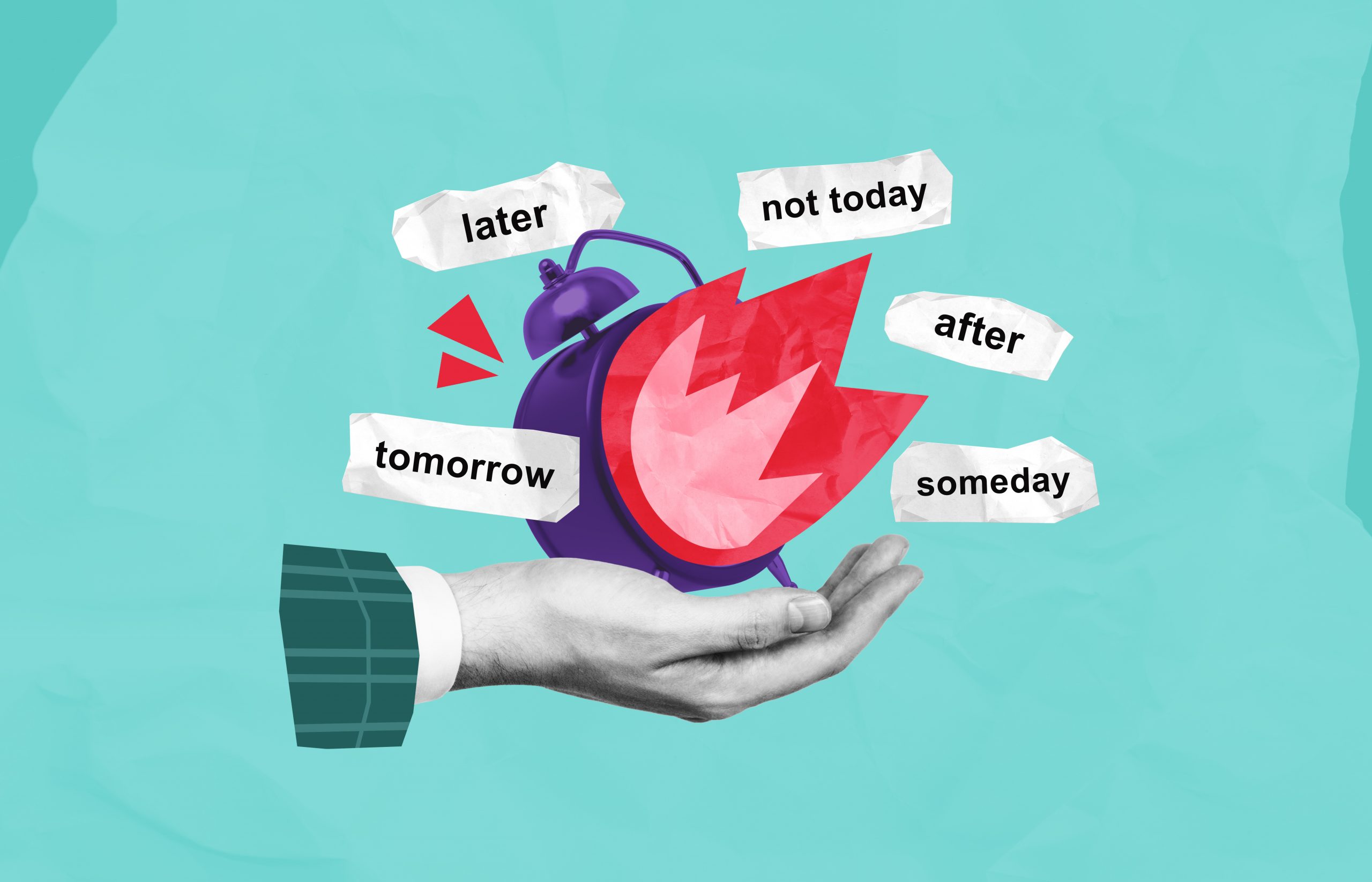
Avoidance behavior can take many forms. One of the most common is procrastination.
You know what you need to do. But the email is still unanswered. The conversation keeps getting rescheduled. The thing you said you would start this week is exactly where it was last week.
Avoidance behavior isn’t simply refusing to do something. It’s repeatedly finding yourself unable to approach a particular task or certain types of tasks. Even though you’re generally functioning well in other areas of your life, you’re not afraid of hard work, and you’re not completely disorganized. But when it comes to certain tasks, you just can’t seem to get yourself to begin.
Sometimes the task is genuinely difficult. Sometimes it isn’t. Either way, the work itself usually isn’t what’s stopping you. It’s what the task represents.
The Link Between Avoidance Behavior and Procrastination

When you keep putting things off, it’s easy to fall into self-criticism. I’m lazy, I’m not disciplined enough, my productivity system is flawed. These negative thought patterns can actually make it even harder to get going on challenging tasks.
In reality, it’s probably not about your personal shortcomings. It might sound strange, but your nervous system may be registering the task as a kind of threat. Not because the task is physically dangerous, but because past experiences have linked it with the possibility of failure, judgment, rejection, uncertainty, or falling short at something that matters.
Procrastination becomes a protective response. You reorganize. You research. You tell yourself you’ll start tomorrow. Every detour creates a little more distance from the discomfort your nervous system is trying to avoid.
Why Avoidance Behavior Can Be Hard to Change
 Ok, you know you’re avoiding the task and the reasons behind that avoidance. So why can’t you get past that block?
The thing is, understanding a behavior and changing it are two different processes. Insight happens in the thinking mind. But when faced with a threat, the nervous system overrides executive thought in favor of a rapid, protective response. Unfortunately, all the thinking in the world may not convince your nervous system that you’re actually safe enough to proceed.
This is why “just do it” so often falls flat. Willpower can help you push through once or twice, but it doesn’t necessarily change the underlying response. As long as a certain type of task makes you uneasy, the cycle is likely to continue.
Sometimes, avoidance behaviors are part of a larger pattern, like functional freeze or functional depression.
Change Starts Small
 Stress response patterns form through experience, so they also shift through experience. Rather than trying to force yourself through the biggest, hardest version of the task, try smaller experiences that tell your nervous system, I can do this, and I’ll be okay.
That might look like:
- Simply opening the document, not working on it, or finishing it
- Sending one email instead of clearing your inbox
- Paying one bill rather than all five stacked on your desk
- Having the first five minutes of the conversation instead of resolving everything at once
Keeping it small lets you approach a task with less trepidation. Ideally, that helps you return enough times to complete it.
Longer-term change happens when the nervous system no longer feels the need to protect you in the same way. With practice, the old discomfort associated with certain tasks can fade, and eventually your brain can see them not as threats but as ordinary tasks again.
For practical ways to regulate your nervous system in the moment, see 5 Ways to Work With Your Nervous System (Not Around It).
Supporting Lasting Change
Mindscape’s low-dose ketamine protocol is designed to support the brain’s capacity to learn new patterns. Ketamine therapy creates an enhanced neuroplastic window, during which the brain becomes more open to forming new associations. Combined with repeated, intentional experiences, this can make it easier to step outside long-standing avoidance patterns and respond differently over time.
Read more about how Mindscape’s unique approach supports lasting change, or take our Clarity Quiz to see if ketamine therapy is a fit for you.
Frequently Asked Questions
What is avoidance behavior?
Avoidance behavior is the tendency to steer away from tasks, situations, or decisions that are likely to produce uncomfortable emotions. It often looks like procrastination, perfectionism, distraction, or staying busy, but underneath it is the nervous system trying to protect you from emotional discomfort rather than the task itself.
Why does avoidance behavior happen?
The nervous system learns from experience. If certain situations have become associated with failure, rejection, criticism, or shame, it begins treating those situations as threats. Avoidance behavior becomes a way of creating distance from the feelings the brain expects to experience.
How do you stop avoidance behavior?
Avoidance behavior usually changes through small, repeated experiences rather than one big act of willpower. Instead of forcing yourself to complete the entire task, make the first step small enough that your nervous system no longer sees it as a threat. Over time, those successful experiences teach your brain that the task is manageable, making it easier to approach the next time.
hi